

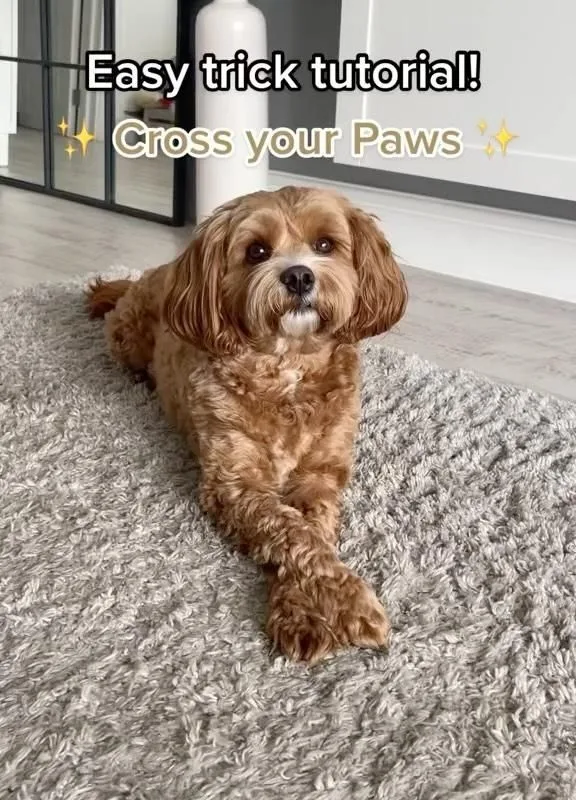
Most dog trick tutorials skip the part that matters: how to break a behavior into pieces small enough that your dog can't fail. Here's the version that worked for me with a treat-obsessed terrier named Pepper, plus the exact steps from creator @littleteddylupin that turn a wobbly paw wave into a reliable high-five.
Advertisements1
- Five treats, three sessions, ninety seconds each beats one long training marathon every time.
- The mark — a click or a spoken "yes" — is a timestamp, not praise. Reward comes after.
- Touch (nose to palm) is the foundation trick that makes spin, roll over, and play dead easier later.
- Fade the treat lure within about ten reps or your dog will only perform for visible food.
- Say a cue once. Repeating it teaches your dog that the word means nothing.
- If a trick collapses, drop back one step — training is a staircase, not an elevator.
Why Trick Training Is Really Attention Training
Here's the thing nobody tells you: teaching a dog to spin in a circle is not actually about the spin. It's about teaching your dog that your face is the most interesting thing in the room. Think of it like a first date — if you're mumbling from the kitchen while scrolling your phone, nobody's leaning in. Same with your dog.
Before you teach a single trick, spend two minutes doing what trainers call "engagement work": stand still, say your dog's name once, and the instant those eyes meet yours, mark it with a click or a cheerful "yes!" and pay with a pea-sized treat. Repeat five times. That's it. You've just installed the software that every trick will run on.
A concrete number to hold onto: five treats per session, three sessions a day, ninety seconds each. That's under five minutes of total training daily, and it beats a single thirty-minute marathon every time. Dogs learn in short, sharp bursts the way we learn a new phone — a little at a time, then sleep on it.
Mark, Reward, Repeat: The Three Words That Do All the Work
Every trick you'll ever teach runs on a simple loop: the dog does something, you mark the exact moment it was right, then you reward. The mark is a clicker or a spoken word like "yes" — it's a timestamp, not praise. Praise comes after, in the form of food or a toy.
Why does the timing matter so much? Imagine trying to teach someone to parallel park by saying "good job" ten seconds after they've already driven away. Useless. Dogs live about 1.3 seconds in the past — reward too late and you're rewarding whatever they're doing now, like sniffing your shoe.
Start with a "charging the marker" session: click or say "yes," then immediately hand over a treat. Do this ten times. By the end, your dog should be visibly perking up at the sound. That's the equivalent of installing a doorbell — now every correct answer gets announced.
Start With the Easiest Trick in the Book: Touch
The first trick I teach every dog is "touch" — nose to palm. It sounds boring, but it's the foundation for spin, roll over, close the door, and about a dozen other behaviors. It's the LEGO brick of trick training.
Hold your palm out flat, about two inches from your dog's nose. Most dogs will investigate out of pure curiosity. The instant that nose makes contact, mark and treat. Do it five times, then move your hand six inches away, then a foot. Within two or three sessions you'll have a dog who follows your hand like a magnet.
Here's the do-this-not-that: don't shove your hand toward your dog's face. That's a push, not a cue, and it teaches nothing except that hands are annoying. Let the dog come to you. If they don't, hold a treat behind your palm so the smell draws them in, and reward the moment of contact.
Shaping vs. Luring: Know Which One You're Using
Two terms worth knowing, both plain as day. Luring means moving a treat in front of your dog's nose to guide them into position — like holding a carrot in front of a donkey. Shaping means waiting for your dog to offer a small piece of the behavior on their own and rewarding each step toward the goal.
Luring is faster, which is why it's great for a quick sit or spin. Shaping is slower but builds a dog who thinks and offers behaviors — the kind of dog who'll invent a trick you didn't ask for. Most trainers use luring to get the behavior once, then fade the treat within about ten repetitions so the dog isn't just following food.
The mistake I see most: people keep the treat in their hand forever, then wonder why the dog won't perform without it. Fade it early. Hand empty, treat appears from your pocket only after the mark.
The Five-Trick Ladder: What to Teach in What Order
Tricks stack, so order matters. Here's the ladder I use, and it maps neatly to what @littleteddylupin demonstrates in their clips.
First, touch (nose to palm). Second, spin — lure the nose around in a circle with a treat, mark the full rotation, and name it "spin" only after the dog completes it reliably. Third, paw or shake — hold a treat in a closed fist near the floor, wait for the paw lift, mark it. Fourth, roll over — lure from a down position, sweeping the treat toward the shoulder. Fifth, play dead — a roll over held for two seconds before you mark.
Notice the pattern: each trick borrows a piece of the one before it. Roll over is just spin lying down. Play dead is roll over with a pause. That's why the ladder works — you're never teaching from scratch, you're remixing.
Naming a Trick: The One-Word Rule
Say the cue once, then wait. If your dog doesn't do it, don't repeat the word — that's how "spin spin spin SPIN" becomes the cue for absolutely nothing. Repeating a cue is like pressing an elevator button forty times; it doesn't make the elevator faster, it just makes you look nervous.
Name the behavior only after it's happening about 80% of the time with your silent lure. Then say the word right before the lure, mark, and treat. Within a handful of reps, the word alone will do the job.
And keep cues to one word with no hand signal attached at first, then add the hand signal later if you like. Dogs read body language far better than words, so if your hand and your mouth disagree, the hand wins every time.
Troubleshooting: When the Trick Falls Apart
Your dog nailed spin yesterday and today they're staring at you like you're a stranger. Congratulations — you've met the "extinction burst," the training equivalent of a vending machine eating your dollar. It's normal, and it usually means the behavior is new and shaky, not lost.
Drop back one step. Reward the half-spin, then the three-quarter spin, then the full one. Training is a staircase, not an elevator — sometimes you have to walk back down a step to go up two.
Also check your environment. A dog on a new rug in a room where the mail just arrived is not the same dog as a dog in a quiet kitchen. Train easy tricks in easy places first, then proof them in the living room, then the yard, then the park. And if your dog's tail is tucked or they're lip-licking, stop. A stressed dog doesn't learn, they just endure.
How to Do It, Step by Step
- 1Charge your marker
Click or say "yes" and immediately treat, ten times in a row. This installs the timestamp that makes every later trick possible. - 2Teach touch first
Hold a flat palm two inches from your dog's nose. Mark and treat the instant the nose makes contact, then move the hand further away each rep. - 3Lure the spin
Move a treat in a slow circle around your dog's nose until they complete a full rotation. Mark the completion, treat, and repeat five times. - 4Fade the lure
Do the same motion with an empty hand. Treat only after the mark. Within about ten reps the treat should live in your pocket, not your fist. - 5Name the trick
Say "spin" once, right before the lure. Never repeat the cue. Mark and treat when the behavior happens. - 6Raise the bar in small steps
Add one second of duration, one step of distance, or one new room at a time — never two at once. If it breaks, drop back a step. - 7Proof it in new places
Practice in the kitchen, then the living room, then the yard. Each new location resets difficulty, so expect a wobbly first rep.
Every trick is just a small behavior stacked on a smaller one, and the dog who learns to offer behaviors will out-trick the dog who learns to wait for a treat.
Frequently Asked Questions
How long does it take to teach a dog a new trick?
Most simple tricks like spin or shake take three to five short sessions of about ninety seconds each. Complex tricks like roll over or play dead can take one to two weeks of daily practice.
What age can you start teaching a puppy tricks?
Puppies can start learning touch and name recognition as early as eight weeks. Keep sessions under sixty seconds and use soft, pea-sized treats so you don't upset their stomach.
Do I need a clicker to train tricks?
No. A spoken marker word like "yes" works just as well as long as you say it in the same tone every time and treat immediately after. A clicker is simply more precise.
Why does my dog only do the trick when I have treats?
You likely haven't faded the lure. Practice with an empty hand, mark the behavior, then reward from your pocket — and start rewarding every other rep instead of every rep.
What is the easiest first trick to teach a dog?
Touch — nose to palm — is the easiest and most useful first trick. It requires no shaping, builds handler focus, and becomes the foundation for spin, roll over, and closing doors.

Kwame writes about technology and digital privacy for everyday users. He breaks down complex topics like data tracking and encryption into simple, relatable terms.


