

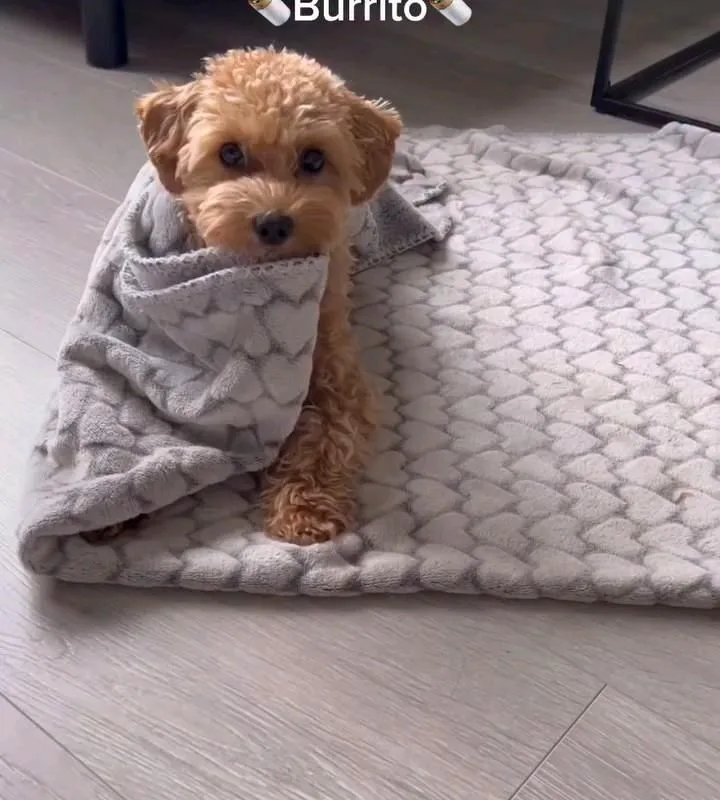
A dog rolled snugly in a blanket looks like pure joy — and it's a surprisingly teachable trick. Here is the calm, step-by-step path I use, built on shaping and a few quiet minutes a day.
Advertisements1
- The burrito trick is a calmness exercise, not a complex sequence — a solid down-stay does most of the work.
- Start with a soft folded fleece, never a heavy quilt, and add one second of contact at a time.
- Never cover the head, and never leave a wrapped dog unattended.
- Attach the verbal cue "burrito" at the final fold, not during the process.
- Five calm repetitions beat twenty rushed ones; end every session on a good note.
Why the Burrito Trick Is Easier Than It Looks
The burrito trick — a dog lying still while a blanket is draped and tucked around them — looks theatrical. In practice it rests on three small behaviors your dog probably already knows: lie down, stay, and tolerate handling. Teach those in pieces and the whole thing assembles itself.
What makes it teachable is that a blanket is a prop, not a cue. The dog isn't learning a complex sequence so much as learning to relax while something soft settles over their back. That is a calmness exercise wearing a costume.
I start almost every dog with a folded fleece — something light and warm that smells like the house. A heavy quilt comes much later. The texture matters more than people expect; a stiff, cold blanket reads as a threat, a soft one reads as a nest.
The Foundation: A Rock-Solid Down-Stay
Before any fabric appears, your dog needs a down-stay they can hold for a full thirty seconds while you move around them. Not a collapsed flop — a settled down with the elbows tucked and the head relaxed.
Build duration in five-second increments, and reward in position rather than releasing. If your dog pops up the moment you reach for a treat, you're paying for standing, not staying. Feed low, between the paws, so the head stays down.
Practice in three short sessions of two minutes rather than one long one. I learned this the slow way with a border collie who could hold a stay for ten minutes but broke the instant a blanket brushed his ear — duration without tolerance is a hollow skill.
Introducing the Blanket Without Fear
Drape, don't wrap, at first. Let the blanket rest over your dog's back for one second, mark, and reward. Then two seconds. The goal is a dog who blinks slowly and stays soft, not one who freezes.
Watch the eyes and the ears. A hard stare, a lifted lip, or ears pinned flat means you moved too fast — go back to the folded fleece and a single second. Consent matters here; a dog who chooses to stay is a dog who is comfortable.
Work on a non-slip mat so the blanket doesn't slide. A little friction underfoot keeps the whole picture steady, and steadiness is what you're really teaching.
Shaping the Tuck
The tuck is where most people rush. Lift one edge of the blanket and fold it gently along your dog's side, never over the face. Reward, then pause. Then the other side.
Tuck the back edge last, near the tail, with a flat palm rather than fingers. Fingers read as grabbing; a flat hand reads as smoothing a bed. Keep your movements slow and your voice low.
If your dog shifts or stands, simply unfold and reset without commentary. The absence of drama is the lesson. I keep sessions to five repetitions maximum — the trick improves in the rest between, not in the repetition itself.
Adding Duration and a Verbal Cue
Once your dog holds the full tuck for three seconds calmly, name it. Say "burrito" once, softly, right as the last fold settles, then reward. The word attaches to the finished picture, not the process.
Extend the hold to ten seconds, then twenty, always ending before your dog wants to leave. A trick that ends on a good note is a trick they'll offer again tomorrow.
Proof it in different rooms and on different surfaces — the sofa, a rug, the porch on a mild day. Generalization is quiet work, but it's what makes the trick reliable when a friend asks to see it.
Reading Your Dog's Comfort Signals
A relaxed burrito dog has soft eyes, a slow blink, and a loose jaw. A stressed one goes still in the wrong way — tense, unblinking, tail tucked tight. Learn the difference; it's the whole game.
Never cover the head, and never leave a wrapped dog unattended. This is a trick performed together, not a restraint. The moment your dog wants out, the blanket comes off, cheerfully and immediately.
Some dogs, especially flat-faced breeds or heavy-coated ones, overheat quickly. Two minutes is plenty. Watch for panting and stop there.
How to Do It, Step by Step
- 1Build a thirty-second down-stay
Reward low between the paws and release only from a settled position. This gives you the stillness the trick requires before any blanket appears. - 2Introduce a folded fleece
Let it rest on your dog's back for one second, mark, reward. Add a second at a time so the fabric becomes familiar rather than startling. - 3Drape over the back only
Keep the head and face clear. Watch for soft eyes and a loose jaw; stop if you see a hard stare or pinned ears. - 4Fold one side, then pause
Use a flat palm and slow movement. Reward, wait, then fold the second side. Rushing here is the most common reason the trick stalls. - 5Tuck the back edge near the tail
Finish with a gentle flat-hand tuck. If your dog stands, unfold calmly and reset without commentary. - 6Name it as the last fold settles
Say "burrito" once, softly, then reward. The cue attaches to the finished picture, not the process. - 7Extend the hold to twenty seconds
Add time gradually and always end before your dog wants to leave, so the trick stays something they offer willingly.
A dog who chooses to stay wrapped is a dog who trusts you — the trick is really a quiet conversation about consent.
Frequently Asked Questions
What age can a dog learn the burrito trick?
Most dogs can start once they have a reliable down-stay, often around six to eight months. Puppies can practice brief one-second drapes earlier, but keep sessions very short and watch for fidgeting.
Is it safe to wrap a dog in a blanket?
Yes, as long as the head stays uncovered and you never leave them unattended. Stop immediately if your dog pants, struggles, or shows a hard stare — the blanket comes off cheerfully and at once.
How long does it take to teach the burrito trick?
With two-minute sessions once or twice a day, most dogs hold a full tuck within two to three weeks. Dogs already fluent in down-stay often get there in under a week.
What if my dog keeps standing up when the blanket touches them?
Go back to a single one-second drape and reward before your dog thinks about moving. Standing usually means you added duration or a fold too quickly, so shrink the step.
Do I need a special blanket for this trick?
A soft, lightweight fleece works best to begin with. Heavier quilts can come later once your dog is relaxed, and a non-slip mat underneath keeps the blanket from sliding.

Ingrid explores Scandinavian minimalist design and slow living. She writes about creating calm, functional spaces with fewer, better things.


