

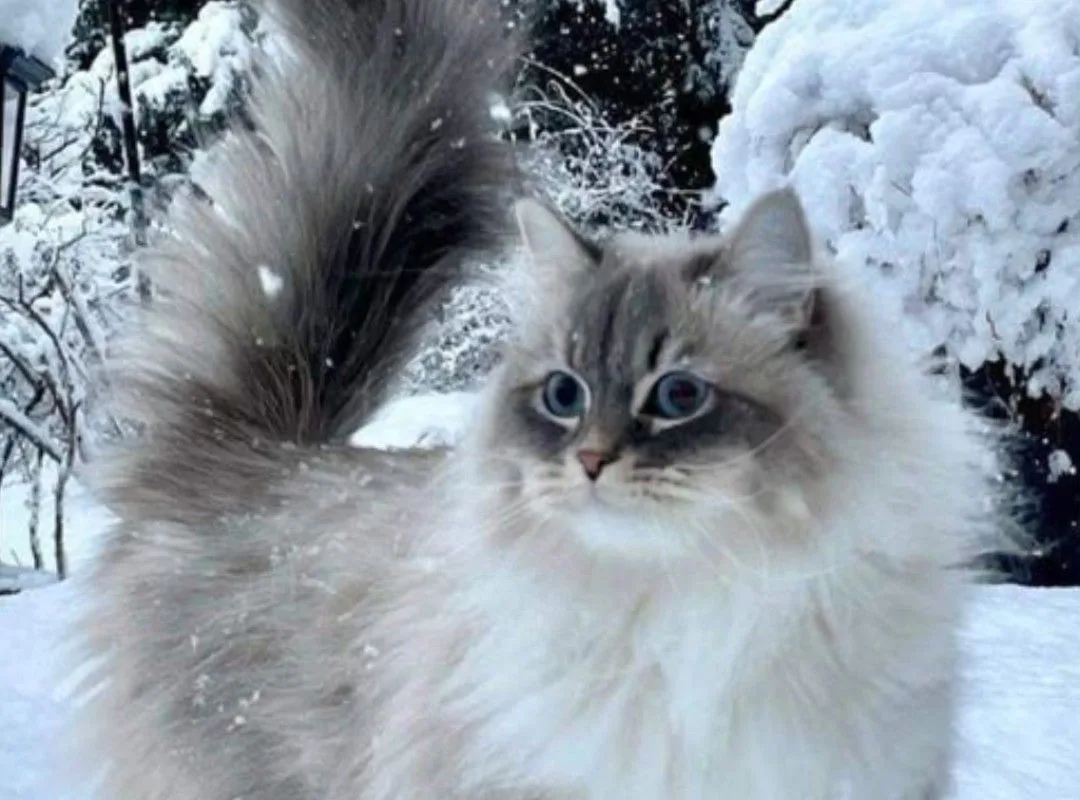
The first time I watched my long-haired cat step onto fresh snow, she lifted one paw, held it suspended like a question, and then placed it down with enormous care. That single gesture taught me more about winter cat care than any article had — and what follows is what I've learned since about letting a fluffy cat meet snow safely.
Advertisements1
- A fluffy cat's double coat handles dry cold well but fails completely once wet — snow type matters more than temperature.
- Lift-and-shake of the same paw three times in a minute means the walk is over.
- Paw balm beats booties for most cats; booties are only worth it if the cat already tolerates foot handling.
- Cap snow walks at two to five minutes and end them while the cat is still interested.
- Wipe paws after every outing — road salt is a real ingestion risk for grooming cats.
- Never force a reluctant cat into snow; a tray of snow indoors gives the same enrichment safely.
Read the paw before you read the weather
A fluffy cat in the snow is not automatically a cold cat. That thick double coat — the dense undercoat plus the longer guard hairs — traps a layer of warm air against the skin, and a Norwegian Forest Cat or Maine Coon can genuinely tolerate a few minutes at -5°C. What it cannot tolerate is wet. Once the undercoat soaks through, the insulation collapses and the cat loses heat fast.
So the useful question is not "how cold is it?" but "is the snow dry and powdery, or wet and clinging?" Dry snow at -10°C is far safer for a two-minute walk than slush at 0°C. Watch the paw lift. A brief hesitation is curiosity. A repeated lift-and-shake, or a cat shifting weight from foot to foot, means the cold has reached the skin and the walk is over.
I keep a simple rule from years of this: if she lifts the same paw three times in under a minute, we go in. No negotiation, no coaxing. The cat is telling me something the thermometer cannot.
Protect the paw pads, but skip the booties at first
Paw pads are the real vulnerability. They are thin, hairless, and in contact with snow, ice, and — in cities — road salt and de-icer, which are caustic and can cause chemical burns and painful cracking. Before any walk, check the pads: they should be smooth and slightly pliable, not dry or fissured.
A thin layer of pet-safe paw balm (look for one with beeswax and shea butter, no petroleum jelly) applied five minutes before going out creates a real barrier. Do this rather than reaching straight for booties. Most cats reject booties on the first attempt and spend the whole walk doing the exaggerated high-step, which defeats the purpose. Balm first, booties only if your cat already tolerates having its feet handled.
After every walk, wipe the paws with a warm damp cloth — not just to dry them, but to remove salt. Cats groom their feet, and ingested de-icer is a genuine toxicity risk. This one habit has saved me more worry than any other.
Let the coat do its job — don't over-dress the cat
There is a persistent belief that a fluffy cat needs a sweater in snow. Usually the opposite is true. A coat that fits badly bunches the fur, rubs the armpits, and actually compresses the insulating layer. For a genuinely long-haired cat, the natural coat is better than anything you can buy.
What matters far more is what happens indoors afterward. Snow clumps — the little icy balls that form between the toes and on the belly fur — need to melt and be combed out, or they mat. I keep a wide-toothed metal comb by the door and do a two-minute check of the belly, armpits, and hind legs as soon as we're back inside. Warm, dry, and combed beats bundled up every time.
Short-haired cats and kittens under six months are a different story. They have less insulation and poorer thermoregulation, and for them a two-minute walk in dry snow is the honest maximum.
Keep the walk short and let the cat lead
The single best thing you can do for a fluffy cat in snow is to make the outing genuinely brief — two to five minutes is plenty for most adult long-haired cats, and it should end while the cat is still curious rather than waiting for distress. A cat that ends the walk interested will want to go again. A cat that ends it shivering will not.
Let the cat set the route. Mine follows the same three metres of path every time, sniffing the same fence post, and that ritual is the point — it's enrichment, not exercise. Forcing a longer walk for the photograph is where things go wrong. The best images come from the second or third short outing, when the cat is relaxed and the light is low and blue.
If the temperature drops below -7°C, or there's wind, we don't go. Wind strips the trapped warm air layer faster than cold alone, and a fluffy cat in a bitter wind is a cat losing heat quickly.
Watch for the quiet warning signs
Cats are stoic, and the signs of cold stress are subtle. Shivering is obvious, but by the time a cat shivers it has already been cold for a while. Earlier signals: the tail tucking tight against the body, the ears flattening back, a hunched posture with the back rounded, and lifting one hind leg off the ground repeatedly.
A cat that suddenly stops moving and sits down in the snow is not being stubborn. That's a cat that has decided the ground is warmer than the air and is a clear signal to pick it up and carry it in. I've done this exactly once, and I'd rather do it once than not at all.
Once inside, dry the cat with a towel — the friction helps — and offer a warm spot but never a hot water bottle or direct heat source. Gradual warming is correct; sudden heat on cold skin is not.
Make the snow a choice, not a test
The most useful shift in my thinking was this: the snow walk is for the cat, not for me. Some fluffy cats adore it and will ask at the door. Others step out once, sniff, and turn around, and that is a complete and valid answer. Never carry a reluctant cat out into snow to see what happens.
Start with the door open and the cat on a harness and lead, in a sheltered spot out of the wind, for thirty seconds. Build from there over weeks, not days. If your cat is indoor-only, a shallow tray of clean snow brought inside gives the same sensory experience with none of the risk — and it is a genuinely good enrichment activity on a grey January afternoon.
The cat decides. My job is only to make the decision safe.
How to Do It, Step by Step
- 1Check the snow type first
Step outside and squeeze a handful. Dry and powdery means a short walk is fine; wet and clinging means skip it, because the undercoat will soak and lose its insulation. - 2Apply paw balm five minutes before
Use a pet-safe beeswax balm on the pads to create a barrier against cold and salt. Wait five minutes so it absorbs rather than wiping straight off. - 3Harness and lead, always
Even a confident cat can bolt when startled by a snowplough or a dog. A well-fitted H-style harness keeps the walk controlled without pressure on the throat. - 4Cap the outing at two to five minutes
End the walk while the cat is still curious. Short, repeated outings build confidence far better than one long one. - 5Wipe the paws on the way in
Use a warm damp cloth to remove salt and de-icer, which are toxic if groomed off and ingested. - 6Comb out snow clumps immediately
Use a wide-toothed metal comb on the belly, armpits, and between the toes once the clumps have melted, before they mat. - 7Dry with a towel, warm gradually
Towel-dry and offer a normal warm spot. Never use a hot water bottle or hairdryer on a cold cat.
A cat that stops and sits down in the snow isn't being stubborn — it has decided the ground is warmer than the air, and that is your signal to carry it inside.
Frequently Asked Questions
Can fluffy cats go outside in the snow?
Yes, most healthy adult long-haired cats can safely spend two to five minutes in dry snow. Their double coat traps warm air, but it loses all insulating value once wet, so avoid wet snow and slush.
How cold is too cold for a cat in the snow?
Below about -7°C, or any temperature with significant wind, keep the cat inside. Wind strips the trapped warm-air layer far faster than still cold air does.
Do cats need boots in the snow?
Usually not. Most cats reject booties and the resulting high-stepping walk defeats the purpose. A pet-safe paw balm gives most of the protection with none of the stress.
How do I know if my cat is too cold outside?
Watch for a tucked tail, flattened ears, a hunched back, or repeatedly lifting a hind leg. Shivering is a late sign — by then the cat has already been cold for some time.
Is road salt dangerous for cats?
Yes. De-icer and road salt are caustic to paw pads and toxic if ingested during grooming. Wipe the paws with a warm damp cloth every time you come back inside.

Ingrid explores Scandinavian minimalist design and slow living. She writes about creating calm, functional spaces with fewer, better things.


