

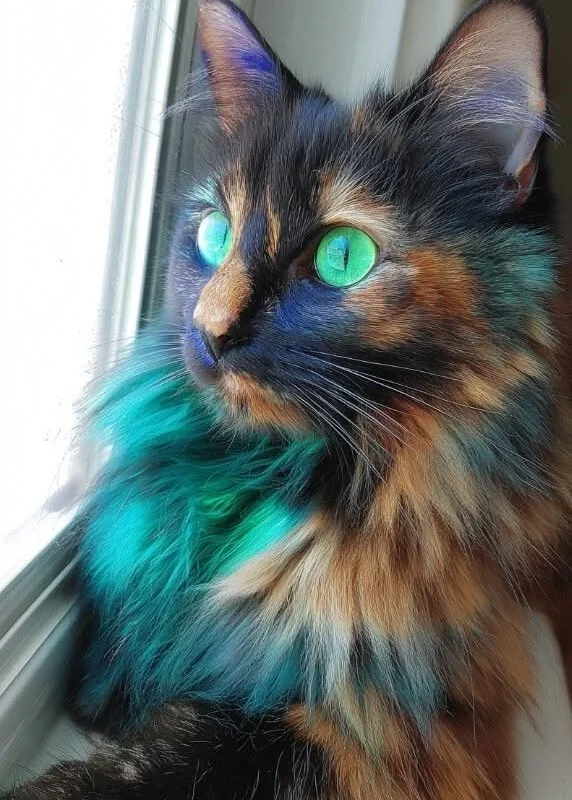
A colorful pretty kitty is not random luck — every patch, stripe, and point color comes from a readable set of genetic switches you can actually learn. Here is how those colors form, what they mean for health and grooming, and how to keep a vivid coat vivid without wasting money on products that do nothing.
Advertisements1
- Coat color is set by two pigments and a handful of genes — O, D, Agouti, and S explain nearly every pattern you see.
- About 80% of orange tabbies are male because the O gene sits on the X chromosome.
- White cats with two blue eyes face a 60–80% deafness risk; test hearing at home and limit sun exposure.
- Groom longhairs 3–4 times weekly and shorthairs twice weekly — neglect costs $80–$150 in mat removal.
- Omega-3 at 20–30 mg/kg EPA+DHA daily improves coat condition; pigment supplements do not change color.
- Skip the $500–$2,000 rare-color premium and spend it on HCM screening and insurance instead.
Why Your Cat's Color Is a Genetic Recipe, Not a Paint Job
Two pigments do all the work: eumelanin (black to brown) and pheomelanin (red to cream). Every color you see is one of those two, diluted or redistributed by specific genes. The O gene on the X chromosome decides orange versus black, which is exactly why roughly 80% of orange tabbies are male — males have one X, so one copy of O makes them orange, while females need two.
The dilution gene (D locus) turns black into blue-gray and orange into cream. The tabby gene (Agouti) decides whether the coat is solid or banded. The white-spotting gene (S locus) controls how much white climbs up the body, from a few toes to a fully white cat with colored points.
Practical takeaway: if you want to predict a litter, count the switches. A black female carrying dilution bred to a blue male gives roughly 50% black and 50% blue, before you even factor in tabby or white spotting. Breeders who track these loci in a simple spreadsheet avoid surprises that cost real money in rehoming.
– Orange cats: ~80% male due to X-linked O gene
– Dilution is recessive: both parents must carry it for blue or cream kittens
– White spotting is additive: more S alleles, more white
The Seven Coat Patterns You Should Be Able to Name
Solid, tabby (mackerel, classic, spotted, ticked), tortoiseshell, calico, colorpoint, bicolor, and smoke. Each has a distinct visual signature, and knowing them helps you describe a cat accurately to a vet, a breeder, or a rescue.
Mackerel tabbies have vertical stripes; classic tabbies have a bullseye swirl on the flank. Ticked tabbies (Abyssinian, Somali) show almost no stripes because each hair has bands of color — that is the Ta gene at work. Calico requires three things at once: the O gene for orange, non-orange for black, and the white-spotting gene for the white base. That combination is why true calicos are almost always female.
Colorpoint cats — Siamese, Ragdoll, Himalayan — carry a temperature-sensitive albinism allele. Pigment only develops in cooler body extremities, which is why kittens are born pale and darken over the first 12 to 24 months, and why a cat kept in a cold room develops darker points. This is not a myth; it is enzyme kinetics.
– Tortoiseshell = mosaic of black and orange, usually female
– Calico = tortie plus white spotting
– Colorpoint = heat-sensitive pigment on ears, face, paws, tail
– Smoke = pale root, dark tip, visible when the coat parts
Grooming by Coat Type: Match the Tool to the Coat
A longhaired colorful kitty needs 10 to 15 minutes of brushing three to four times a week; a shorthair needs 5 minutes twice a week. Skip this and you get matting that costs $80 to $150 to shave out at a groomer, plus stress on the cat.
Use a stainless steel greyhound comb for longhairs and a rubber curry or fine-toothed flea comb for shorthairs. Slicker brushes are fine on the surface but do not reach the undercoat, which is where mats start. Work in sections: behind the ears, armpits, britches, and tail base are the four mat hotspots on a Persian or Maine Coon.
Bathing is overused. A healthy cat grooms itself effectively; bathe only for medical reasons or genuine soiling, roughly every 6 to 8 weeks at most. Overbathing strips the sebum that gives a vivid coat its sheen and can cause dry, flaky skin within two weeks.
– Longhair: 3–4 sessions/week, 10–15 min each
– Shorthair: 2 sessions/week, ~5 min each
– Bath frequency: max every 6–8 weeks unless medically directed
– Mat removal cost if neglected: $80–$150 at a groomer
Feeding for Color: What Actually Reaches the Coat
Coat color is genetic, but coat condition is nutritional — and a dull coat reads as a washed-out coat. The two nutrients with real evidence behind them are omega-3 fatty acids (EPA and DHA) and adequate protein.
Aim for a diet with at least 30% protein on a dry-matter basis for adult cats, and consider a fish-oil supplement at roughly 20 to 30 mg combined EPA+DHA per kilogram of body weight per day. For a 4 kg cat, that is 80 to 120 mg daily. Compare that to a typical 1,000 mg fish-oil capsule, which contains maybe 300 mg combined EPA+DHA — so a quarter capsule covers a small cat. Do the math before you dose, and check with your vet if the cat is on blood thinners or has kidney disease.
Skip biotin megadoses and "color-enhancing" treats. There is no credible evidence they shift pigment in a genetically fixed coat. What they do reliably is add calories.
– Protein: ≥30% dry matter for adult maintenance
– Omega-3: 20–30 mg/kg EPA+DHA daily
– 4 kg cat = 80–120 mg/day total
– Avoid unproven pigment supplements
Color-Linked Health Risks You Should Know
Some colors correlate with real medical risks, and knowing them helps you ask better questions at the vet.
White cats with blue eyes carry a markedly higher risk of congenital deafness — studies put it at roughly 60–80% for white cats with two blue eyes, versus about 20% for white cats with non-blue eyes. Test hearing at home by rattling keys out of sight. White cats also have thinner skin and higher rates of squamous cell carcinoma on the ear tips and nose; limit sun exposure and use vet-approved pet sunscreen on pale noses.
Certain lines of colorpoint cats (Siamese, Burmese) show higher rates of progressive retinal atrophy and crossed eyes, though responsible breeding has reduced these. Maine Coons and Ragdolls — often colorful — carry elevated risk of hypertrophic cardiomyopathy (HCM), affecting an estimated 1 in 7 in some screened populations. Ask for a cardiac ultrasound before buying a kitten.
– White + blue eyes: 60–80% deafness risk
– White cats: higher SCC risk on ear tips and nose
– HCM screening: ask for echo results on parents
– Any color: pet insurance quote before the first vet bill
Photographing a Colorful Coat Without Washing It Out
Pinterest is full of flat, muddy cat photos because people shoot in auto mode under warm indoor bulbs. The fix is simple and free.
Shoot near a north-facing window in indirect daylight, between 10 a.m. and 2 p.m. Turn off overhead lights — mixed color temperatures make orange cats look brown and blue cats look gray. Set your phone to a fixed white balance (or tap the white patch of a calico and lock exposure), then underexpose by about one-third of a stop so the highlights in a white coat do not blow out.
For tortoiseshell and calico cats, get low and shoot at eye level — the pattern reads best across the flank, not from above. For colorpoints, use a slightly cooler white balance (around 5000K) to keep the points from going muddy.
– Best light: indirect window light, 10 a.m.–2 p.m.
– White balance: lock it, do not use auto
– Exposure: −0.3 EV to protect white fur
– Angle: eye level for pattern, side-on for tortie
Choosing a Colorful Kitten Without Getting Burned
Color is the least important thing about a cat, but it is the first thing people pay a premium for. A rare color can add $500 to $2,000 to a price tag with zero health benefit.
Ask for the parents' genetic testing: HCM echo, PKD (polycystic kidney disease) DNA test for Persians and related breeds, and FeLV/FIV status. A breeder who cannot produce those documents in under five minutes is a risk. Expect to pay $800 to $2,500 for a well-bred pedigreed kitten in the US; anything under $400 for a "rare" color is a red flag for a kitten mill.
Rescues are full of stunning calicos, torties, and orange tabbies for a $75 to $200 adoption fee that includes spay/neuter, vaccines, and a microchip. Run the numbers: a $150 adoption plus a $60 vet check beats a $1,500 impulse purchase every time.
– Ask for HCM echo and PKD DNA results
– Fair pedigreed price: $800–$2,500
– Adoption fee: $75–$200, usually includes spay/neuter and vaccines
– Under $400 for a "rare" color: walk away
Keeping the Coat Vivid Long-Term
A vivid coat is a maintenance habit, not a product. Three things drive it: consistent grooming, adequate hydration, and a low-stress environment.
Cats are chronically underhydrated on dry food. Add a water fountain (many cats prefer running water) and consider mixing 1 to 2 tablespoons of water into wet food per meal. Dehydrated cats get dull, brittle coats within a month.
Stress shows up in the coat too — over-grooming, barbering, and patchy fur are common stress signals. Feliway diffusers and predictable routines help. If you see bald patches on a tortie or calico, rule out fleas and ringworm before assuming anxiety.
– Water fountain plus 1–2 tbsp water in wet food daily
– Groom 2–4x weekly depending on coat length
– Watch for over-grooming as a stress signal
– Annual vet check with a skin and coat review
Where the Money Actually Goes
Budget realistically. A colorful kitten is a 15- to 20-year financial commitment, and the color does not change the cost structure.
First-year costs run $1,200 to $2,500: adoption or purchase, spay/neuter, vaccines, microchip, litter box, carrier, food, and a first dental check. Annual ongoing costs land around $600 to $1,200 for food, litter, and routine vet care. Add $300 to $600 per year for pet insurance if you want to hedge the HCM or cancer risk.
Compare that to a $1,500 "rare color" premium and the math is obvious: put the money into health screening and insurance instead. A healthy, well-groomed cat of any color photographs better than a sick one with a rare coat.
– First year: $1,200–$2,500
– Ongoing: $600–$1,200/year
– Insurance: $300–$600/year
– Rare-color premium: $500–$2,000 with no health benefit
How to Do It, Step by Step
- 1Identify the coat pattern
Name the pattern — solid, tabby, tortie, calico, colorpoint, bicolor, or smoke — before you shop for grooming tools. The pattern tells you the coat length and undercoat density you are dealing with, which determines the brush you need. - 2Match the brush to the coat
Use a greyhound comb for longhairs and a rubber curry or flea comb for shorthairs. Slicker brushes miss the undercoat where mats begin, so they are a supplement, not a primary tool. - 3Set a grooming schedule
Brush longhairs 3–4 times a week for 10–15 minutes and shorthairs twice a week for about 5 minutes. This prevents $80–$150 groomer mat-removal bills and reduces hairball frequency. - 4Audit the diet
Confirm at least 30% protein on a dry-matter basis and add omega-3 at 20–30 mg/kg EPA+DHA daily. For a 4 kg cat that is 80–120 mg per day — measure it, do not guess. - 5Screen for color-linked risks
Test hearing on white cats with blue eyes, limit sun on pale noses, and request HCM echo results on Maine Coon or Ragdoll parents. These are the risks that actually cost money later. - 6Lock your camera settings
Shoot in indirect window light between 10 a.m. and 2 p.m., lock white balance, and underexpose by one-third stop. This keeps white fur from blowing out and stops orange from reading brown. - 7Budget before you buy
Plan $1,200–$2,500 for year one and $600–$1,200 annually. Put the rare-color premium into health screening and insurance instead — the return is measurable.
Color is genetics, but a vivid coat is maintenance — you cannot feed or brush a cat into a color it was not born with, and you do not need to.
Frequently Asked Questions
Are calico cats always female?
Almost always — true calicos need two X chromosomes to carry both orange and black pigment plus the white-spotting gene. Male calicos occur at roughly 1 in 3,000 and are usually sterile due to XXY chromosome makeup.
Why do Siamese kittens get darker as they age?
They carry a temperature-sensitive albinism allele, so pigment only develops in cooler body areas like the ears, face, paws, and tail. Kittens are born pale and darken over 12 to 24 months as their body temperature regulation matures.
Do color-enhancing cat foods actually work?
No — they cannot change genetically fixed pigment. What they can do is improve coat shine through omega-3 fatty acids, which makes existing color look richer. Look for 20–30 mg/kg EPA+DHA rather than marketing claims on the bag.
Are white cats more prone to health problems?
Yes, particularly deafness and skin cancer. White cats with two blue eyes have a 60–80% deafness rate, and pale ear tips and noses are more vulnerable to squamous cell carcinoma, so limit sun exposure.
How much should I budget for a colorful kitten?
Plan $1,200–$2,500 for the first year and $600–$1,200 annually after that. A $75–$200 rescue adoption that includes spay/neuter and vaccines is far better value than a $1,500 rare-color purchase with no health screening.

Diego covers personal finance and investing for freelancers and gig workers. His angle is practical money management for irregular income, from budgeting to tax basics.


