

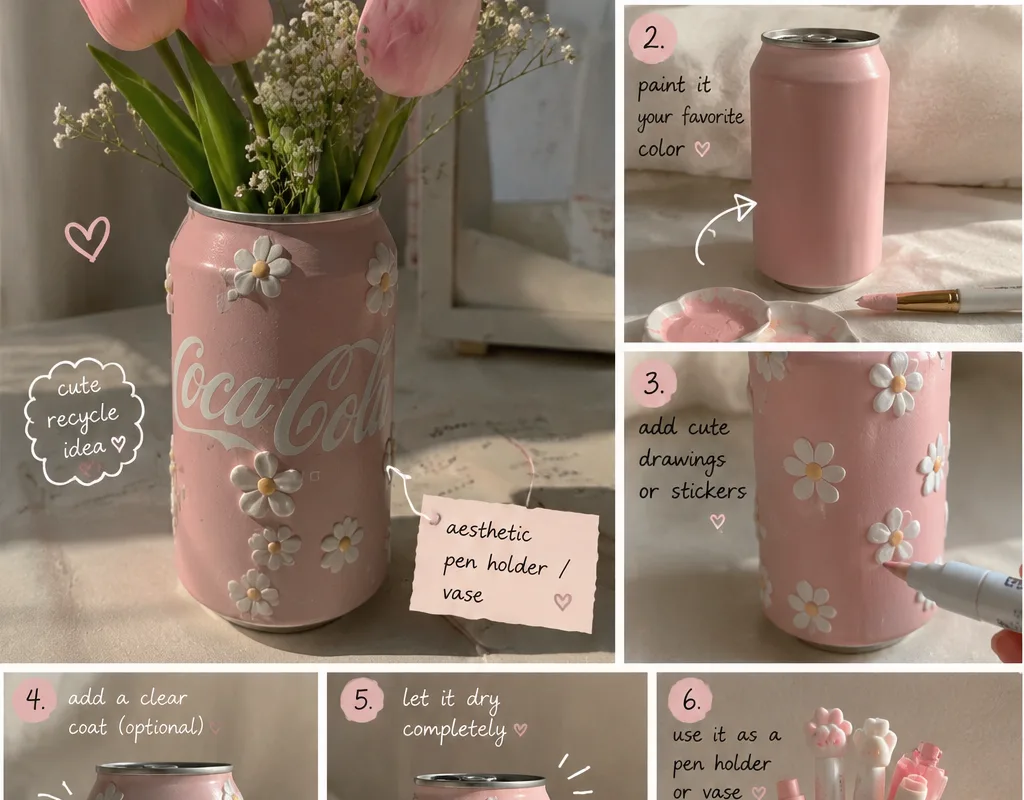
Picture a crushed Coke can that looks like a battered little accordion — and then imagine it flattened, coiled, and reborn as a gleaming rose on your windowsill. Coke cane craft (also called soda-can crafting or can-weaving) is one of the most satisfying upcycles out there, and these seven hacks will get you from 'where do I even start?' to a finished piece you'll actually want to display.
Advertisements1
- Freeze the can with water for 2 hours before flattening — it prevents dents and creases.
- Score with an awl and snap; scissors leave ragged, dangerous edges.
- Punch every hole while the metal is flat to avoid cracks at bends.
- Two thin coats of clear acrylic beat one thick coat every time.
- Keep holes 5 mm from edges and store finished roses in an egg carton.
Hack 1: Flatten Before You Cut — The Rolling Pin Method
Before scissors ever touch metal, flatten your Coke can properly. Rinse it, fill it with water and freeze it for about 2 hours, then lay it on a folded towel and roll it flat with a rolling pin, working from the center outward. The ice keeps the can rigid so it presses into a clean sheet instead of crumpling into a jagged mess. Once flat, the aluminum behaves like stiff cardstock — easy to mark, easy to cut, easy to curl.
Why it works: frozen water supports the thin aluminum walls from the inside, so pressure distributes evenly instead of denting one spot. You get a smooth, workable panel roughly 4 by 7 inches from a standard 12 oz can.
The common mistake: rolling a warm, empty can. It dents, creases, and the creases become tear points later. Also skip the freezer overnight — a fully frozen can can split at the seams as it expands. Two hours is the sweet spot.
Hack 2: Score, Don't Saw — The Awl and Ruler Technique
The cleanest Coke cane craft cuts come from scoring, not hacking. Clamp your flattened can to a cutting mat, lay a metal ruler along your cut line, and drag a craft awl or the back of a utility blade along it 3–4 times with light pressure. Then bend the metal back and forth along the score line until it snaps free. You'll get a straight edge within about 1 mm, versus the wavy, sharp-fringed edge you get from scissors.
Why it works: aluminum work-hardens at the score line, so repeated light passes create a controlled fracture instead of a ragged shear. It's the same principle jewelers use to cut sheet metal.
The common mistake: pressing too hard on the first pass. Heavy pressure makes the blade skip and gouges the surface, leaving a scar that shows through on the finished side. Light and many beats hard and few.
Hack 3: The Glove-and-Tape Safety Combo
Soda-can edges are thinner than paper and sharper than a chef's knife. Before your first cut, put on snug nitrile-coated gardening gloves (not loose cotton — loose fabric catches and pulls your hand toward the blade). Then wrap a strip of painter's tape along the cut line and cut through it. The tape holds tiny metal slivers in place and gives your fingers a visual boundary.
Why it works: the tape acts as a sacrificial layer, trapping microfragments that would otherwise fly up and lodge in your fingertips. It also reduces glare so you can actually see your pencil line.
The common mistake: using masking tape and leaving it on for days. The adhesive bakes onto aluminum and leaves a sticky ghost line that resists even rubbing alcohol. Peel within an hour, and use painter's tape for anything decorative.
Hack 4: Punch Your Holes Before You Bend
If you're making a Coke cane lantern, wind chime, or woven panel, punch every hole while the metal is still flat. Use a 1/16-inch hole punch or a nail set over a scrap of wood, spacing holes 1 cm apart for weaving and 2 cm for hanging. Bending first and drilling later is how you get cracked edges and a wonky pattern.
Why it works: flat metal distributes the punch force evenly; curved metal concentrates stress at the bend and splits. Pre-punching also lets you test your pattern on paper first — trace the can shape, punch the paper, then use it as a template.
The common mistake: punching right at the edge. Keep holes at least 5 mm from any cut edge, or the aluminum will tear out the moment you thread wire through it.
Hack 5: Coil and Twist for Coke Can Roses
For the classic Coke can rose, cut a 1-inch-wide strip the full length of the flattened can (about 7 inches), then cut that strip into five petals of decreasing length: 5, 4, 3, 2, and 1.5 inches. Curl each petal around a pencil, slip it off, and hot-glue them in a spiral from largest to smallest onto a wire stem. The printed red side faces out; the silver interior becomes your highlight.
Why it works: aluminum holds a curl with almost no springback, so petals keep their shape without wire. Layering from big to small mimics how a real rose opens, and the printed Coca-Cola red reads as a deliberate design choice rather than an accident.
The common mistake: gluing while the petals are still curled tight around the pencil. Let each petal relax for 30 seconds first, or your rose will look like a clenched fist instead of a bloom.
Hack 6: Seal the Shine With Clear Acrylic
Bare aluminum oxidizes and dulls within weeks, and cut edges stay sharp forever. Brush two thin coats of water-based clear acrylic (matte for a vintage look, gloss for glass-like shine) over every surface, including the back and the edges. Let each coat dry 20 minutes. A 2 oz bottle covers roughly 15 small projects.
Why it works: the acrylic seals out moisture and oxygen, and it rounds the microscopic burr on cut edges so you can handle your piece without fear. It also locks in the printed graphics, which otherwise scuff off with handling.
The common mistake: spraying a heavy coat in one pass. Thick acrylic pools at the low points, turns cloudy, and can flake off in sheets. Two thin coats always beat one fat one.
Hack 7: Store Flat, Display Proud
Finished Coke cane craft pieces hate humidity and love being flat. Store flat panels between two sheets of cardboard with a book on top, and hang finished pieces away from steamy windows or stove splatter. For a woven panel, mount it on a wooden frame with a 1 cm gap so air circulates behind it.
Why it works: thin aluminum warps with temperature swings and traps moisture against glass, which clouds the acrylic finish. A small air gap keeps the metal stable and the shine intact.
The common mistake: stacking finished roses in a box. They crush each other's petals. A cheap egg carton is the perfect petal-safe display tray — one bloom per cup.
The Hacks, Step by Step
- 1Rinse and freeze the can
Fill the empty can with water, freeze 2 hours, then roll flat with a rolling pin on a towel for a smooth panel. - 2Tape and score your cut lines
Apply painter's tape, clamp a metal ruler, and score 3–4 light passes with an awl before snapping the metal along the line. - 3Punch holes while flat
Mark and punch all weaving or hanging holes at least 5 mm from edges before any bending. - 4Cut petals largest to smallest
Slice a 1-inch strip into 5, 4, 3, 2, and 1.5-inch petals for a layered Coke can rose. - 5Curl and relax
Wrap each petal around a pencil, slip it off, and wait 30 seconds before gluing in a spiral. - 6Seal with two thin coats
Brush water-based clear acrylic on all surfaces and edges, drying 20 minutes between coats. - 7Store and display flat
Keep panels between cardboard and finished roses in an egg carton away from humidity.
Aluminum doesn't need to be tamed — it needs to be understood, and once you know how it wants to bend, the can practically makes the art for you.
Frequently Asked Questions
Is Coke cane craft safe for beginners?
Yes, with gloves and painter's tape on every cut line. The metal is thin but sharp, so nitrile-coated gardening gloves and a taped edge turn a risky hobby into a controlled one.
What's the best way to cut a soda can without jagged edges?
Score the line 3–4 times with an awl against a metal ruler, then bend the metal back and forth until it snaps. This gives a clean edge within about 1 mm instead of a ragged scissor cut.
How do I stop my Coke can art from dulling?
Brush two thin coats of water-based clear acrylic over all surfaces and edges. The acrylic seals out moisture and oxygen and locks in the printed graphics.
Can I use other soda cans for the same projects?
Absolutely — any aluminum can works, though Coke cans give that iconic red-and-white palette. Thinner cans flatten more easily but dent faster, so test one before committing to a batch.
How long does a Coke can rose last?
Indefinitely indoors if sealed with acrylic and kept away from humidity. Store it in an egg carton to protect the petals, and avoid steamy windowsills.


