

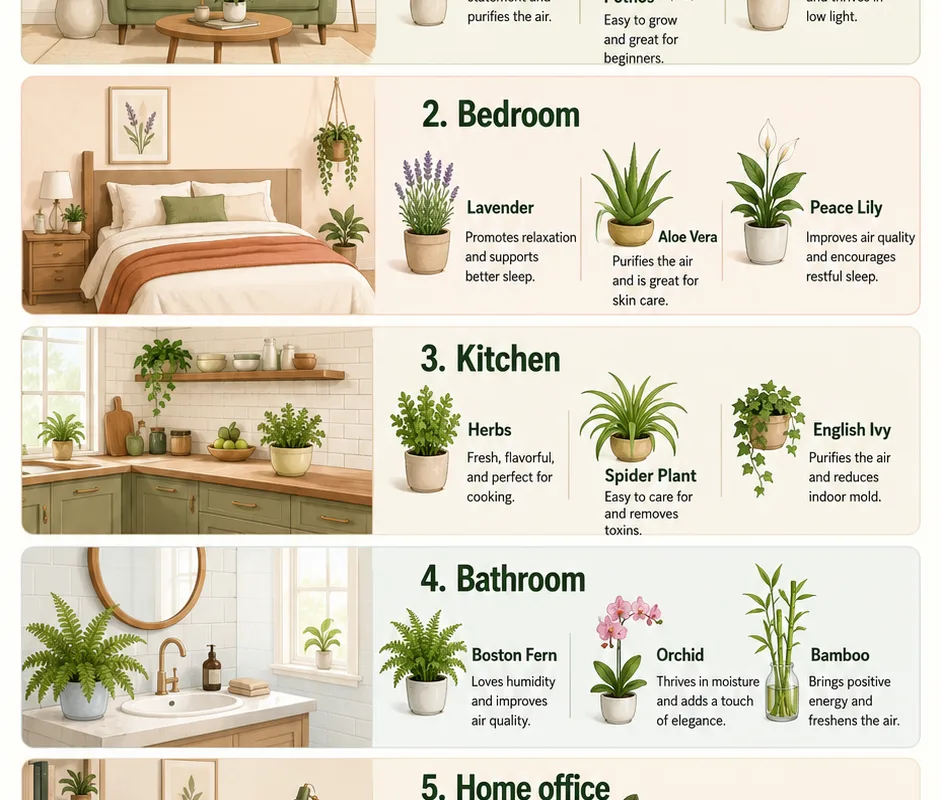
The problem is simple: most people buy a plant because it looks good, then place it wherever there’s an empty corner. Weeks later it’s drooping, the room feels no better, and the plant gets blamed. But placement isn’t decoration — it’s biology. A plant that wants bright indirect light will fail in a dim bedroom, and a humidity-loving fern will crisp up next to a radiator. Match the species to the room’s light, moisture, and temperature, and the same plant suddenly earns its keep.
Advertisements1
Quick win: before you buy anything below, walk each room at noon and at dusk and note how much natural light hits the spot you have in mind. That single five-minute habit will save you more plants than any fertilizer.
Table of Contents(Click to Toggle)
Why Room-by-Room Plant Placement Actually Matters
Every room in a home has a different microclimate. A bathroom holds moisture and filtered light; a south-facing living room gets hours of direct sun; a bedroom stays cool and dark for most of the day. Plants evolved for specific conditions, and when you respect those conditions, three things happen at once: the plant thrives instead of merely surviving, you stop wasting money replacing dead ones, and you get the ambient benefits — cleaner-feeling air, a calmer visual anchor, a reason to open the curtains — that made you want plants in the first place.
Below are sixteen plants, each paired with the room where it genuinely belongs and the reason it works there. I’ve kept the notes practical: light needs, watering rhythm, and the one limitation worth knowing before you commit.
16 Best Plants for Every Room in Your Home
1. Snake Plant : The Bedroom Workhorse That Tolerates Neglect
What it is: A slow-growing succulent with upright, sword-shaped leaves, widely sold as Sansevieria or Dracaena trifasciata.
Category: Low-light tolerant, low-maintenance indoor plant.
Why it stands out:
- Performs a different type of photosynthesis (CAM) that lets it keep its stomata closed during the day, so it uses less water and is unusually forgiving of dry air.
- Survives in the dim, cool conditions most bedrooms offer.
- Its vertical form fits narrow corners and bedside gaps.
Best for: Bedrooms and hallways where light is scarce and watering is irregular. The main limitation: overwatering is the one thing that kills it, so let the soil dry fully.
2. Peace Lily : A Clear Signal When It Needs Water
What it is: A glossy-leaved tropical plant (Spathiphyllum) that produces white spathes a few times a year.
Category: Medium-light, moisture-loving flowering plant.
Why it stands out:
- It visibly droops when thirsty and recovers within hours of watering — an honest, low-stakes feedback loop for new plant owners.
- Handles the indirect light of a living room or home office well.
- Its broad leaves create a soft visual mass that fills empty corners.
Best for: Living rooms and offices with bright, filtered light. Note it prefers consistently moist (not soggy) soil and dislikes direct afternoon sun.
3. Boston Fern : Built for the Bathroom’s Humidity
What it is: A dense, arching fern (Nephrolepis exaltata) with fine fronds that thrive in moist air.
Category: High-humidity, indirect-light plant.
Why it stands out:
- Bathrooms are one of the few rooms that naturally replicate a fern’s native humidity, so it stops browning at the tips.
- The cascading form works on a shelf or hanging basket where floor space is tight.
- It responds quickly to good conditions, filling out within a season.
Best for: Bathrooms with a window or bright artificial light. Limitation: it will crisp up in dry, heated rooms, so keep it away from radiators.
4. Aloe Vera : A Sun-Loving Kitchen Counter Plant
What it is: A rosette succulent with fleshy, gel-filled leaves.
Category: High-light, drought-tolerant succulent.
Why it stands out:
- Wants the brightest spot you have — a sunny kitchen windowsill is close to ideal.
- Needs water only every two to three weeks, which suits a busy household.
- Its compact size fits counters and windowsills without crowding them.
Best for: Bright kitchens and sunny entryways. Limitation: it etiolates (stretches thin) in low light, so don’t tuck it into a dark corner.
5. Pothos : The Trailing Plant That Forgives Almost Anything
What it is: A vining aroid (Epipremnum aureum) with heart-shaped leaves, often called devil’s ivy.
Category: Adaptable, low-to-medium-light vine.
Why it stands out:
- Tolerates a wide light range, from bright indirect to a dim office corner.
- Trails beautifully from bookshelves and high cabinets, adding vertical interest without floor space.
- Propagates easily in water — one plant becomes several.
Best for: Home offices and living rooms. Limitation: keep it out of reach of pets, since it’s toxic if chewed.
6. Spider Plant : Fast Growth for a Kid’s Room
What it is: A grassy, arching plant (Chlorophytum comosum) that sends out baby plantlets on runners.
Category: Bright-indirect, beginner-friendly plant.
Why it stands out:
- Grows quickly and visibly, which makes it rewarding for children to care for.
- The plantlets can be snipped and potted — a cheap, hands-on lesson in propagation.
- Adapts to average room light and temperature.
Best for: Kids’ rooms and studies. Limitation: fluoride in tap water can brown the leaf tips, so filtered water helps.
7. Rubber Plant : A Structural Anchor for the Living Room
What it is: A large-leaved ficus (Ficus elastica) that grows into a small indoor tree.
Category: Bright-indirect, medium-maintenance statement plant.
Why it stands out:
- Its glossy, dark leaves give a living room a deliberate, architectural focal point.
- Grows tall enough to fill a bare corner without needing a stand.
- Prefers stable conditions — once settled, it’s low-effort.
Best for: Living rooms with good light. Limitation: it dislikes being moved and drafts; pick a spot and leave it.
8. ZZ Plant : The Office Plant That Survives Your Vacation
What it is: A waxy-leaved aroid (Zamioculcas zamiifolia) with thick underground rhizomes that store water.
Category: Low-light, drought-tolerant plant.
Why it stands out:
- Its rhizomes hold moisture, so it can go three to four weeks without watering.
- Handles fluorescent office lighting that would starve most plants.
- Its upright habit stays tidy on a desk or in a corner.
Best for: Home offices and windowless corners. Limitation: growth is slow and it’s toxic to pets if ingested.
9. Lavender : A Fragrant Entryway Welcome
What it is: A woody Mediterranean herb with silvery foliage and purple flower spikes.
Category: Full-sun, dry-soil herb.
Why it stands out:
- Needs maximum sun and gritty, fast-draining soil — a bright entryway or porch suits it.
- The scent greets you at the door and doubles as a natural room freshener.
- Attracts pollinators if placed near an open doorway.
Best for: Sunny entryways and porches. Limitation: it rots in rich, wet potting soil, so use a cactus mix.
10. English Ivy : A Cascading Screen for Shelves
What it is: A classic climbing vine (Hedera helix) with lobed leaves.
Category: Cool, bright-indirect vine.
Why it stands out:
- Prefers cooler rooms, making it a good fit for a hallway or a bright stairwell.
- Trails densely over shelf edges, softening hard lines.
- Grows steadily with modest care.
Best for: Hallways and cool, bright corners. Limitation: it needs consistent moisture and is toxic to pets.
11. Areca Palm : A Soft, Airy Divider for Open Spaces
What it is: A clustering palm (Dypsis lutescens) with feathery fronds.
Category: Bright-indirect, humidity-friendly palm.
Why it stands out:
- Its height and density make it a natural room divider in an open-plan living area.
- Fronds move gently with air currents, adding life to a static space.
- Prefers bright, filtered light and steady moisture.
Best for: Open living rooms and sunrooms. Limitation: it browns in dry air, so mist or group it with other plants.
12. Philodendron : A Reliable Bathroom Companion
What it is: A broad family of tropical aroids, many of them vining, with bold heart-shaped leaves.
Category: Medium-light, humidity-tolerant tropical.
Why it stands out:
- Enjoys the humidity a bathroom offers and tolerates lower light than many tropicals.
- Several varieties (heartleaf, brasil) trail neatly from a shelf.
- Grows quickly enough to be satisfying without being invasive.
Best for: Bathrooms and kitchens with indirect light. Limitation: toxic to pets, so place it high.
13. Orchid : A Low-Water Focal Point for the Bathroom
What it is: A flowering epiphyte (commonly Phalaenopsis) grown in bark rather than soil.
Category: Bright-indirect, low-water flowering plant.
Why it stands out:
- Its roots prefer the humid air of a bathroom and the bright, filtered light near a frosted window.
- Blooms last for weeks, giving a room a long-lasting focal point.
- Watering is simple: soak the bark, then let it drain fully.
Best for: Bathrooms and bright kitchens. Limitation: it rots if water sits in the crown, so drain carefully.
14. Cast Iron Plant : The Hallway Survivor
What it is: A tough, leathery-leaved plant (Aspidistra elatior) named for its resilience.
Category: Low-light, low-maintenance plant.
Why it stands out:
- Tolerates dim hallways, temperature swings, and irregular watering better than almost anything else.
- Its broad leaves add green mass where little else will grow.
- Slow-growing, so it stays put for years.
Best for: Dark hallways and north-facing rooms. Limitation: it grows very slowly, so buy a mature specimen.
15. Chinese Evergreen : Patterned Color for a Dim Bedroom
What it is: A compact aroid (Aglaonema) bred for patterned, often pink or silver foliage.
Category: Low-to-medium-light foliage plant.
Why it stands out:
- One of the few colorful plants that still performs in lower light.
- Stays compact, fitting a nightstand or dresser top.
- Prefers evenly moist soil and average room temperature.
Best for: Bedrooms and dim living corners. Limitation: toxic to pets and sensitive to cold drafts.
16. Herbs (Basil and Mint) : A Working Kitchen Windowsill
What it is: Culinary herbs grown in small pots on a sunny sill.
Category: Full-sun, fast-growing edible plants.
Why it stands out:
- They need the brightest, sunniest spot in the house — typically a kitchen window.
- They’re functional: snip as you cook, and the plant responds with bushier growth.
- They make plant care part of a daily routine.
Best for: Sunny kitchens. Limitation: basil sulks below about 10°C and mint spreads aggressively, so keep it in its own pot.
Bonus Mentions
Calathea : Dramatic Foliage for a Humid Bathroom
What it is: A patterned tropical that folds its leaves at night.
Category: High-humidity, medium-light plant.
Why it stands out:
- Its leaf movement is genuinely fascinating to watch.
- Thrives in bathroom humidity.
Best for: Patient owners who can keep soil evenly moist.
Jade Plant : A Sunny Windowsill Succulent
What it is: A branching succulent (Crassula ovata) with plump oval leaves.
Category: Full-sun succulent.
Why it stands out:
- Stores water in its leaves, needing little attention.
- Develops a tree-like shape over years.
Best for: Bright, south-facing windowsills.
Bird’s Nest Fern : A Compact Bathroom Accent
What it is: A rosette fern (Asplenium nidus) with wavy, undivided fronds.
Category: Medium-light, humidity-loving fern.
Why it stands out:
- Compact enough for a small bathroom shelf.
- Prefers the moisture a shower provides.
Best for: Small, humid bathrooms with soft light.
String of Hearts : A Delicate Trailing Accent
What it is: A slender trailing succulent (Ceropegia woodii) with heart-shaped leaves.
Category: Bright-light trailing succulent.
Why it stands out:
- Its fine trails suit a bright bedroom shelf.
- Needs infrequent watering.
Best for: Bright rooms where a light touch is wanted.
Peperomia : A Tiny Desk Plant for the Office
What it is: A compact genus of small, fleshy-leaved plants.
Category: Medium-light, low-water plant.
Why it stands out:
- Small footprint fits a cluttered desk.
- Tolerates average office light.
Best for: Desks and small shelves.
Matching the Plant to the Room, Not the Trend
The pattern across all sixteen is the same: the room’s light, humidity, and temperature decide the winner, not the plant’s reputation. A snake plant in a dark bedroom will outperform an expensive flowering plant that needs sun, and a Boston fern in a bathroom will outlast the same fern in a heated living room. Before your next purchase, spend five minutes reading the room — literally — and let that decide.
Which room in your home is still missing the right plant, and what light does it actually get?
Stay focused, stay light.

Kenji covers tech productivity and digital minimalism for remote workers. He writes about streamlining workflows and cutting digital clutter with a focus on mental clarity, not just efficiency.


