

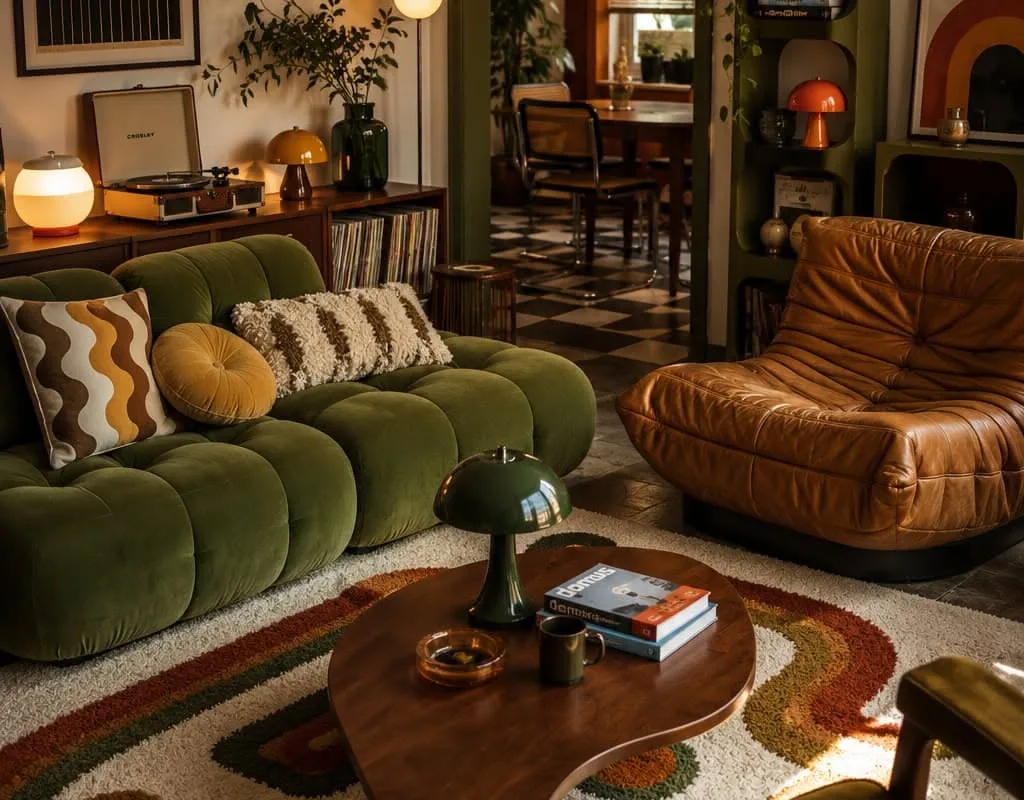
The afternoon light falls across my grandmother’s walnut sideboard in a way that makes the brass handles glow like small suns. I have moved that piece through four apartments. It never quite fits. It always belongs.
Advertisements1
That tension — the old thing that refuses to leave, the new room that keeps asking for air — is where retro living rooms are born. Not as a museum of the past, but as a conversation between decades. A 1960s lamp beside a linen sofa. A teak shelf holding a wireless speaker. Warmth and function, sitting quietly together.
Below are twenty ideas I keep returning to, each one a small way to let vintage charm and modern comfort share the same square of floor.
Table of Contents(Click to Toggle)
- Why Retro Living Rooms Feel Like Home Again
- Retro Living Room Ideas That Blend Vintage Charm With Modern Comfort
- 1. Mid-Century Walnut Credenza as Media Console
- 2. Arched Floor Lamp with a Dimmable Smart Bulb
- 3. Low-Slung Sofa in Boucle or Linen
- 4. Vintage Persian Rug Under a Minimal Coffee Table
- 5. Warm Ochre and Burnt Orange Accent Wall
- 6. Rattan Peacock Chair as a Reading Corner
- 7. Chrome and Glass Coffee Table from the 1970s
- 8. Retro Smeg-Style Fridge in a Living Nook
- 9. Fluted Wood Paneling Behind the Sofa
- 10. Layered Lighting with Vintage Milk Glass Pendants
- 11. Terrazzo Side Table for a Touch of 1950s Italy
- 12. Curved Velvet Armchair in Forest Green
- 13. Retro Bar Cart Styled as a Coffee Station
- 14. Geometric 1970s Wallpaper on One Wall
- 15. Vinyl Record Player on an Open Teak Shelf
- 16. Slatted Room Divider for Open-Plan Rooms
- 17. Vintage Ceramic Table Lamps with New Shades
- 18. Chunky Knit Throw Over a Leather Sofa
- 19. Retro Poster Art in Thin Brass Frames
- 20. Smart Thermostat and Hidden Cable Management
- Bonus Mentions
- A Quiet Observation on Living with the Past
Why Retro Living Rooms Feel Like Home Again
Modern interiors are beautiful, but they can feel a little airless. Everything is new, everything matches, and nothing remembers anything. Retro design brings memory into the room. A worn edge on a wooden armrest. A color that only exists because someone in 1972 loved it.
What makes this moment different is that we no longer have to choose. A vintage sideboard can hide a streaming box. A 1960s lamp can run on an LED that costs pennies. The charm stays; the inconvenience goes.
There is also a quieter reason. In a world of disposable furniture, a piece that has already survived fifty years carries a certain calm. You are not the first person to sit beside it. You will not be the last.
Retro Living Room Ideas That Blend Vintage Charm With Modern Comfort
1. Mid-Century Walnut Credenza : A vintage anchor that hides modern cables
What it is: A low, long wooden cabinet from the 1950s or 1960s, usually walnut or teak, with sliding doors and tapered legs.
Category: Furniture and storage.
Why it stands out: Its proportions were designed for rooms without televisions, which makes it perfect for hiding one today. Drill a discreet hole in the back panel and every router, console, and cable disappears behind warm wood grain.
Best for: Anyone who wants a media wall that does not look like a media wall.
2. Arched Floor Lamp : 1970s silhouette, modern dimmable light
What it is: A tall lamp with a curved chrome or brass stem and a wide, shallow shade that throws light upward.
Category: Lighting.
Why it stands out: The arch creates a soft pool of light exactly where you read, and a smart bulb lets you shift from warm 2200K in the evening to brighter daylight for tasks. The retro shape does the decorating; the bulb does the work.
Best for: Reading corners and rooms with high ceilings.
3. Low-Slung Sofa : Comfort that does not block the view
What it is: A sofa with a low back and deep seat, often in boucle, linen, or a soft wool blend.
Category: Seating.
Why it stands out: Low backs were standard in mid-century rooms because they keep sightlines open, making small spaces feel larger. Choose a removable-cover model and you get modern practicality without losing the soft, rounded profile.
Best for: Open-plan apartments and anyone who likes to see over the sofa.
4. Vintage Persian Rug : Pattern that grounds a minimal room
What it is: A hand-knotted wool rug, often faded to soft rose and indigo, laid under a simple modern coffee table.
Category: Flooring and texture.
Why it stands out: A single patterned rug can carry an entire room of plain furniture. Wool also wears gracefully — a little thinning in the traffic path reads as character, not damage. Look for hand-knotted pieces rather than machine copies.
Best for: Rooms that feel too flat or too new.
5. Warm Ochre Accent Wall : One wall of 1970s sunshine
What it is: A single wall painted in ochre, burnt orange, or muted mustard, with the remaining walls in soft plaster white.
Category: Color and paint.
Why it stands out: These colors were everywhere in the 1970s for a reason — they flatter wood tones and make lamplight feel golden. Modern low-VOC paints mean you get that warmth without the old fumes.
Best for: North-facing rooms that never quite warm up.
6. Rattan Peacock Chair : A dramatic seat that stays light
What it is: A high-backed woven rattan chair with a fan-shaped frame, popular from the 1960s through the 1980s.
Category: Accent seating.
Why it stands out: It reads as sculpture when empty and as a throne when occupied. Because it is woven, it never feels heavy in a small room the way an upholstered chair might.
Best for: A corner that needs presence, not bulk.
7. Chrome and Glass Coffee Table : 1970s shine, easy to clean
What it is: A low table with a tubular chrome frame and a clear or smoked glass top.
Category: Tables.
Why it stands out: Glass visually disappears, so the room keeps its floor space even with a large table. A smoked top hides fingerprints better than clear glass, and the chrome reflects lamplight in the evening.
Best for: Small rooms and anyone with a busy household.
8. Retro-Style Fridge : A 1950s curve with a modern compressor
What it is: A refrigerator with rounded corners, a chrome handle, and a pastel or cream finish.
Category: Appliances.
Why it stands out: In an open-plan living space, the fridge is part of the view. A retro model turns a functional box into a piece of furniture, while modern insulation and inverter motors keep it quiet and efficient.
Best for: Kitchen-living rooms where the fridge is always visible.
9. Fluted Wood Paneling : Texture behind the sofa
What it is: Vertical slats or fluted panels in oak, ash, or walnut, mounted on one wall.
Category: Wall treatment.
Why it stands out: Fluting adds shadow and rhythm without pattern, and it absorbs a little sound — genuinely useful in echoey modern rooms. It also gives a plain wall somewhere for the eye to rest.
Best for: Rooms with tall blank walls and hard floors.
10. Milk Glass Pendants : Layered light with a vintage glow
What it is: Opal or milk glass pendant shades, often with brass fittings, hung in a row or as a cluster.
Category: Lighting.
Why it stands out: Milk glass diffuses light softly, so you get brightness without glare. Hanging three at different heights creates a warm, layered look that a single ceiling fixture can never match.
Best for: Dining zones inside living rooms.
11. Terrazzo Side Table : A slice of 1950s Italy
What it is: A small table or stool with a speckled terrazzo top and slim metal or wooden legs.
Category: Accent furniture.
Why it stands out: Terrazzo is forgiving — it hides water rings and small scratches — and its speckled surface picks up every color already in the room. One piece is enough; the material is loud on its own.
Best for: Beside an armchair, holding a lamp and a cup.
12. Curved Velvet Armchair : Softness in a deep, saturated green
What it is: A rounded armchair in velvet, often in forest green, rust, or deep teal.
Category: Seating.
Why it stands out: Velvet catches light along its curves, so the chair changes as the day passes. Deep greens and rusts are period-appropriate for the 1960s and 1970s, and they pair easily with wood and brass.
Best for: Adding one rich color to a neutral room.
13. Retro Bar Cart : A coffee station that rolls
What it is: A two-tier cart with brass or chrome rails and small casters, from the 1950s or 1960s.
Category: Storage and styling.
Why it stands out: Bar carts are endlessly useful beyond drinks — a coffee station, a plant stand, a place for books and a speaker. Wheels mean you can move it out of the way when the room needs to breathe.
Best for: Small rooms that need flexible storage.
14. Geometric 1970s Wallpaper : Bold pattern, one wall only
What it is: A wallpaper with large geometric or abstract shapes in mustard, brown, and cream.
Category: Wall treatment.
Why it stands out: Modern paste-the-wall papers are far easier to hang and remove than their 1970s ancestors. Use it on a single wall behind a plain sofa and the pattern reads as art rather than noise.
Best for: Renters using removable versions, and anyone craving pattern.
15. Vinyl Record Player : Analog ritual on an open teak shelf
What it is: A turntable with built-in speakers or a small amplifier, sitting on an open wooden shelf.
Category: Audio and decor.
Why it stands out: Playing a record is a physical act — choosing, cleaning, lowering the needle — and that slowness suits a retro room. Modern turntables with Bluetooth output let you keep the ritual and still connect to a hidden speaker.
Best for: Anyone who wants music to be a small ceremony.
16. Slatted Room Divider : Separation without walls
What it is: A folding screen or fixed slatted panel in wood, cane, or rattan.
Category: Space planning.
Why it stands out: It defines a living zone inside an open plan without blocking light, and it gives you somewhere to hide a charging station or a pile of magazines. Cane versions add texture from both sides.
Best for: Studio apartments and long, narrow rooms.
17. Vintage Ceramic Lamps : Old bases, new shades
What it is: Ceramic lamp bases from the 1960s or 1970s, fitted with fresh linen or pleated shades.
Category: Lighting.
Why it stands out: Changing the shade is the cheapest way to modernize a vintage lamp. A crisp new shade in oatmeal linen makes even a very dated base look intentional, and the old ceramic carries a color no factory produces now.
Best for: Thrifted finds and inherited lamps.
18. Chunky Knit Throw : Softness over a leather sofa
What it is: A heavy, textured throw blanket in wool or cotton, draped over the back of a leather or vinyl sofa.
Category: Textiles.
Why it stands out: Leather sofas are period-perfect but can feel cold. A chunky throw adds warmth and softens the room’s acoustics. Cream or oatmeal keeps it modern; rust or mustard pushes it further back in time.
Best for: Making a vintage sofa feel lived-in, not staged.
19. Retro Poster Art : Thin brass frames, big personality
What it is: Vintage exhibition posters, travel prints, or film posters, framed simply in brass or black metal.
Category: Wall art.
Why it stands out: These prints were designed to be seen from across a room, so their colors and lettering hold up at scale. Thin frames keep the focus on the artwork rather than the frame, which suits a modern wall.
Best for: Filling a large wall without a gallery grid.
20. Smart Thermostat and Cable Management : The invisible modern layer
What it is: A smart thermostat, smart plugs, and simple cable channels or boxes that hide the technology.
Category: Technology and organization.
Why it stands out: This is the idea that makes the whole list work. Modern comfort lives in the walls and behind the furniture — warm floors, scheduled lamps, no visible wires. The vintage pieces get the credit; the technology stays out of sight.
Best for: Anyone who wants a period room that still functions like a new one.
Bonus Mentions
Estate Sale Listings : Where the best vintage furniture actually surfaces
What it is: Online marketplaces and local estate sale listings where mid-century pieces appear at reasonable prices.
Category: Sourcing.
Why it stands out: Unlike curated vintage shops, estate sales price furniture by the room, not by the trend. You may need to collect it yourself, and condition varies, but the value is unmatched.
Best for: Patient hunters with a van and a free Saturday.
Design Archives : Period references that keep you accurate
What it is: Photo archives of interiors from the 1950s through the 1980s.
Category: Reference and inspiration.
Why it stands out: Seeing how a room was actually arranged in 1968 prevents the common mistake of mixing eras that never met. It is research, but it is pleasant research.
Best for: Anyone planning a renovation and wanting to get the details right.
Smart Bulbs : Change the mood without changing the lamp
What it is: App-controlled bulbs that fit standard sockets inside vintage fixtures.
Category: Lighting technology.
Why it stands out: Warm white at 2200K makes old brass and wood glow; brighter daylight helps you clean and organize. One bulb, two rooms, depending on the hour.
Best for: Making vintage lighting practical for daily life.
Restoration Guides : Small repairs that save old pieces
What it is: Step-by-step guides for refinishing wood, reupholstering, and repairing vintage hardware.
Category: Maintenance.
Why it stands out: A wobbly leg or a dull finish is often a twenty-minute fix, not a reason to discard a good piece. Learning one repair skill extends the life of everything you own.
Best for: Beginners who want to keep what they find.
Mood Boards : Plan the palette before you buy
What it is: A digital or physical board collecting colors, textures, and furniture shapes you love.
Category: Planning.
Why it stands out: Retro rooms go wrong when too many eras compete. A mood board shows you the common thread — usually two or three colors and one wood tone — before you spend money.
Best for: Anyone starting from an empty room.
A Quiet Observation on Living with the Past
The best retro rooms are not the most authentic ones. They are the ones where a single old thing is allowed to matter — a lamp, a chair, a rug that has already lived a life — and everything around it is quiet enough to let that thing speak.
Modern comfort is not the enemy of vintage charm. It is the frame around it. Hidden cables, soft light, warm floors: none of it shows, and all of it makes the old pieces easier to live with every single day.
I still have the walnut sideboard. It still does not quite fit. I have stopped trying to make it.
Which vintage piece in your home refuses to leave, and what have you built around it? I would genuinely like to know.
Less, but better.

Ingrid explores Scandinavian minimalist design and slow living. She writes about creating calm, functional spaces with fewer, better things.


