

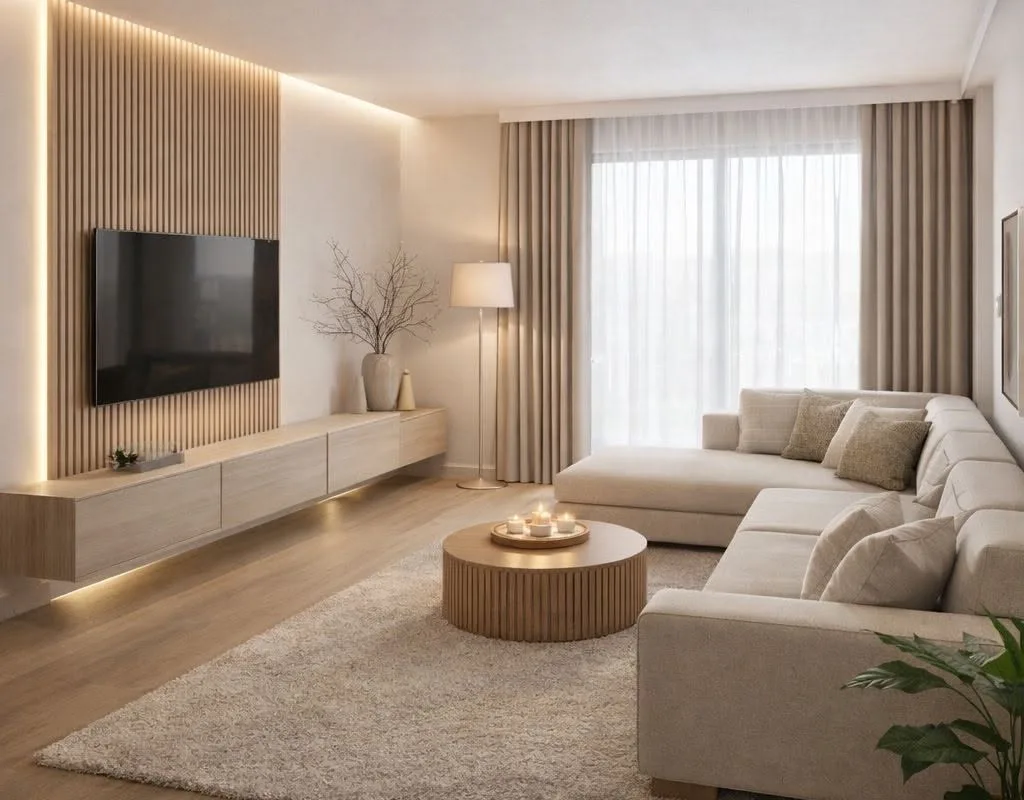
Most minimalist living rooms fail for the same reason: they optimize for emptiness instead of warmth. You remove the clutter, paint everything white, and end up with a room that looks like a furniture showroom nobody lives in. Japandi fixes that specific problem. It merges Japanese restraint with Scandinavian comfort, so the result stays calm but still feels inhabited.
Advertisements1
Quick win: before you scroll, pick one anchor piece in your living room (a sofa, a low table, a lamp) and remove everything within two feet of it. That single move creates the negative space Japandi relies on, and it costs nothing.
Table of Contents(Click to Toggle)
Why Japandi Solves the Cold Minimalist Problem
Japandi is not a trend invented by mood boards. It is a practical response to two design traditions that each solved half the problem. Japanese interiors handle negative space, natural light, and honest materials. Scandinavian interiors handle softness, function, and livability through long dark winters.
Put them together and you get rules you can actually apply:
- Low horizontal lines so the eye rests instead of climbing.
- Warm neutrals (oat, clay, charcoal, undyed wool) instead of stark white.
- One or two statement materials — paper, oak, stone, linen — repeated until they feel intentional.
- Visible emptiness around furniture, not between it.
The brands below are the ones designers actually specify when they want this result, not just the ones with the loudest marketing. Each entry notes a concrete product or material detail so you can judge whether it fits your room.
16 Japandi Living Room Ideas Worth Stealing
1. Muuto : The easiest entry point into warm Scandinavian minimalism
What it is: A Copenhagen brand built around new Nordic furniture, lighting, and accessories with soft geometry.
Category: Furniture and lighting.
Why it stands out: The Rest sofa and Outline series use low backs and rounded arms that read calm without feeling flimsy. Their Leaf and Unfold lamps add diffused light, which is the single most important element in a Japandi room. Most pieces ship in muted fabric ranges that already match the palette.
Best for: Anyone furnishing a first Japandi living room who wants pieces that age well.
2. Ferm Living : Texture-first pieces that keep minimalism from feeling sterile
What it is: A Danish brand known for graphic patterns, ceramics, and warm material mixes.
Category: Furniture, textiles, decor.
Why it stands out: Their Pond and Ripple glassware and the Herman shelving use honest materials — smoked glass, oak, wool — that add the tactile layer Japandi needs. Their cushion and throw ranges in bouclé and linen are a cheap way to soften a hard-edged sofa.
Best for: Layering texture into a room that already has its big furniture sorted.
3. Menu : Sculptural objects that double as functional furniture
What it is: A Danish design house focused on minimalist objects with strong silhouettes.
Category: Furniture and accessories.
Why it stands out: The JWDA lamp is a marble-and-glass table lamp that works as both lighting and sculpture, which is exactly the Japandi trick of making one object do two jobs. Their Eave sofa and Umanoff daybed use slender frames that keep floor space visible.
Best for: Small living rooms where every object needs to earn its footprint.
4. Frama : Apothecary-calm design with raw, honest materials
What it is: A Copenhagen studio working across furniture, lighting, and skincare with a restrained palette.
Category: Furniture, lighting, home objects.
Why it stands out: Frama’s St Pauls and 9.5° shelving systems use untreated oak and steel, and their Eiffel and Cirque lighting leans on simple cones and spheres. The brand’s refusal to over-finish wood is the most Japanese thing about it.
Best for: People who want visible grain and patina rather than lacquered surfaces.
5. Skagerak : Outdoor-grade woodcraft that works beautifully indoors
What it is: A Danish brand specializing in FSC-certified oak and teak furniture.
Category: Furniture and outdoor-to-indoor pieces.
Why it stands out: The Virkelyst and Messina series use slatted, low-slung forms that echo Japanese joinery. Because the pieces are built for weather, they handle real-life wear in a living room better than delicate finishes. Their Dania and Vester benches are ideal low tables.
Best for: Households with kids or pets where furniture takes punishment.
6. Carl Hansen & Søn : Heritage woodwork that anchors a room for decades
What it is: A Danish manufacturer producing classic mid-century designs, including Hans J. Wegner pieces.
Category: Premium furniture.
Why it stands out: The CH24 Wishbone chair and CH327 table are the closest thing Scandinavian design has to Japanese restraint — thin frames, visible joinery, no ornament. One good chair here does more for a room than five decorative objects.
Best for: Buyers who would rather own one lasting piece than replace three cheap ones.
7. Karimoku Case Study : Literally Japanese and Scandinavian in one collection
What it is: A collaboration line from Japanese wood manufacturer Karimoku with Nordic architects and designers.
Category: Furniture.
Why it stands out: This is the most on-the-nose Japandi resource that exists, because the pieces are designed by Scandinavian studios but built with Japanese woodworking tolerances. The Case Study sofas and lounge chairs use solid oak and low proportions with extremely tight joinery.
Best for: Anyone who wants the real thing rather than a reinterpretation of it.
8. Artek : Bent birch and daylight, straight from Helsinki
What it is: The Finnish brand co-founded by Alvar Aalto, still producing his bentwood designs.
Category: Furniture and lighting.
Why it stands out: Aalto’s Paimio and Stool 60 use laminated birch that curves like Japanese bentwood without a single hard corner. Their A330S pendant throws a warm, indirect glow that mimics paper lantern light — a core Japandi lighting move.
Best for: Rooms with pale wood floors that need furniture in the same family.
9. Vitra : A design archive you can actually buy from
What it is: A Swiss furniture company holding the rights to many twentieth-century design classics.
Category: Furniture and lighting.
Why it stands out: For Japandi, the useful pieces are the quiet ones: the Soft Modular sofa, the Noguchi table, and the Akari light series. The Akari paper lanterns alone can convert a harsh room into a warm one, and they come in over a hundred shapes.
Best for: Adding one iconic, low-key piece rather than a full matching set.
10. Gubi : Statement silhouettes with a soft, muted palette
What it is: A Danish design house reviving mid-century pieces alongside new work.
Category: Furniture and lighting.
Why it stands out: The Multi-Lite and Grossman lamps, plus the Pacha lounge chair, give a Japandi room one deliberate point of interest without clutter. Gubi’s fabric program leans heavily into oatmeal, clay, and sage, so upholstery rarely clashes.
Best for: Breaking up an all-neutral room with a single sculptural shape.
11. HAY : Accessible Scandinavian design without the premium markup
What it is: A Danish brand producing furniture and accessories at mid-market prices.
Category: Furniture, lighting, decor.
Why it stands out: HAY is the practical answer when you want the look on a budget. The Mags sofa, About A Chair, and the Kaleido trays cover the essentials, and their textiles are genuinely good for the price. Quality is honest rather than heirloom, which is fine for pieces you may swap later.
Best for: Renters and first apartments where flexibility matters more than longevity.
12. New Tendency : Industrial minimalism softened by warm finishes
What it is: A Berlin-based studio making furniture with a precise, reduced aesthetic.
Category: Furniture and shelving.
Why it stands out: Their Meta shelving and Plate tables use powder-coated steel in muted tones with solid wood tops. The combination gives you the clean lines of Japanese storage without the coldness of pure metal. Modular systems like this let you build exactly the wall unit your room needs.
Best for: Open-plan living rooms that need storage without visual noise.
13. &Tradition : A catalogue that covers both halves of Japandi
What it is: A Danish brand with a broad range spanning Nordic and Japanese-influenced designers.
Category: Furniture and lighting.
Why it stands out: The Inland sofa by Anderssen & Voll and the Flowerpot lamp are staples, but the more relevant pieces are the Drawn and Vito series — slim, wood-framed, and quiet. Their collaboration with Japanese-influenced studios makes the catalogue unusually coherent for a Japandi scheme.
Best for: Sourcing several pieces that need to look like they were chosen together.
14. Mater : Sustainability as a design constraint, not a slogan
What it is: A Danish brand focused on ethical production and recycled or responsibly sourced materials.
Category: Furniture and lighting.
Why it stands out: The Earth stool and Bow lamp use waste materials and biodegradable composites, and the Highline and Materia ranges keep forms simple. For Japandi, the appeal is that the pieces look handmade rather than manufactured.
Best for: Buyers who care where the material came from as much as how it looks.
15. We Do Wood : Small-space furniture built on Japanese proportions
What it is: A Danish maker specializing in compact, flat-pack wooden furniture.
Category: Furniture and storage.
Why it stands out: The Scoreboard shelving and Molecule tables are designed for tight rooms, with low heights and open frames that keep sightlines clear. Everything is solid oak or ash, so the pieces warm up a pale room immediately.
Best for: Apartments where a standard sofa-and-coffee-table layout will not fit.
16. Normann Copenhagen : Playful forms kept in check by muted color
What it is: A Danish brand covering furniture, lighting, and small objects.
Category: Furniture, lighting, decor.
Why it stands out: The Block and Journal tables, plus the Amp lamp, show how to introduce a curved shape without breaking a calm palette. Their smaller objects — trays, vases, hooks — are useful for filling shelf gaps without adding clutter.
Best for: Finishing touches once the main furniture is already in place.
Bonus Mentions
MUJI : The most direct route to Japanese restraint on a budget
What it is: A Japanese retailer selling simplified home goods and furniture.
Category: Furniture and storage.
Why it stands out: Their oak shelving units and linen bedding are the cheapest credible way to build a Japandi base layer.
Best for: Storage and textiles rather than statement furniture.
Takt : Flat-pack furniture with real joinery
What it is: A Danish brand making assemble-it-yourself pieces from certified wood.
Category: Furniture.
Why it stands out: Their Cross and Soft chairs use visible joints and honest finishes instead of hidden hardware.
Best for: Anyone who wants craft details without a craft price tag.
IKEA : The volume option for testing a layout before committing
What it is: The global Swedish retailer.
Category: Furniture and storage.
Why it stands out: Their oak-veneer and rattan ranges let you prototype a Japandi layout cheaply, then upgrade piece by piece.
Best for: Testing proportions in a room before spending on heirloom items.
Hem : Direct-to-consumer design with clean geometry
What it is: A design brand selling furniture and objects online.
Category: Furniture and decor.
Why it stands out: The Kumo sofa and Palo shelving keep lines simple and colors restrained, with fewer middlemen in the price.
Best for: Online buyers who want design credibility without showroom pricing.
TON : Bentwood chairs that bridge both traditions
What it is: A Czech manufacturer producing bentwood furniture since the nineteenth century.
Category: Seating and tables.
Why it stands out: Their steam-bent chairs have the same lightness as Japanese woodwork at a fraction of designer pricing.
Best for: Dining and accent seating in a warm, pared-back room.
The Quiet Rooms Nobody Regrets Building
Japandi is not about buying a specific brand. It is about deciding what your room is allowed to contain, then holding that line. The brands above are useful because they already made that decision for you — low lines, honest materials, muted color, and enough negative space to let the light do the work.
A practical order of operations: fix your lighting first, choose one anchor piece of furniture second, and only then add texture through textiles and small objects. Most people do it backward and end up with a room full of things that individually look fine and collectively look busy.
Which Japandi piece in your own living room ended up mattering more than you expected when you bought it?
Stay focused, stay light.

Kenji covers tech productivity and digital minimalism for remote workers. He writes about streamlining workflows and cutting digital clutter with a focus on mental clarity, not just efficiency.


