

Ever stood in a bakery at 7 a.m., watching steam curl out of a croissant and thought, I could never make that? Spoiler: you absolutely can. Laminating dough is basically folding a love letter to butter, over and over, until it turns into a hundred paper-thin pages.
Advertisements1
Think of it like making a bed with too many sheets: dough, butter, dough, butter, tuck, chill, repeat. The cold is your co-pilot here. Every time the butter stays chilly, you win another layer of flaky magic.
This recipe is written for real kitchens with real schedules. No marble slab, no pro sheeter, no intimidating French vocabulary exam. Just flour, butter, patience, and a rolling pin that's about to become your new best friend.
Why You'll Love This Recipe
About the Ingredients
4 cups (500g) bread flour, plus extra for dusting
Bread flour's higher protein gives the gluten strength to stretch around all that butter. All-purpose flour works in a pinch, but the layers will be slightly less dramatic.
1/2 cup (100g) granulated sugar
Just enough sweetness to let the butter shine. Reduce to 1/3 cup if you plan to make savory ham-and-cheese versions.
2 1/4 tsp (7g) active dry yeast
One standard packet. If yours is older than six months, proof it in the warm milk first to make sure it's still alive.
1 1/4 cups (300ml) whole milk, lukewarm (about 100F/38C)
Whole milk gives richness and a tender crumb. Oat milk works as a swap, though the final crumb will be a touch leaner.
1 1/2 tsp (9g) fine sea salt
Salt isn't optional here; it strengthens gluten and keeps the flavor from tasting flat. Kosher salt works, but use a little less by volume.
2 tbsp (28g) unsalted butter, softened, for the dough
This goes into the base dough itself, separate from the laminating butter. Don't skip it; it keeps the crumb soft.
1 1/2 cups (340g) European-style unsalted butter, cold, for laminating
Look for butter with 82% or more butterfat, like Plugra or Kerrygold. Standard butter works but releases more water and can make the layers greasier.
1 large egg, beaten with 1 tbsp water, for egg wash
This is your golden-shine glaze. A splash of cream instead of water gives an even deeper, glossier bronzed finish.
Tips & Tricks
Keep Everything Cold
If your butter starts sweating or your dough feels warm, stop and chill for 20 minutes. Warm butter smears into the dough instead of creating distinct layers.
Roll in One Direction
Roll away from you in long, even strokes rather than back and forth. This keeps the butter block rectangular and the layers uniform.
Don't Rush the Proof
Cold dough needs a long, slow rise at room temperature, sometimes 2 hours. Rushing it means dense, bready croissants instead of airy ones.
Sharp Cuts Matter
Use a pizza wheel or very sharp knife to cut triangles. A dull edge pinches the layers shut and blocks the rise.
Pro Tips
Step-by-Step Instructions
1. Mix the Base Dough
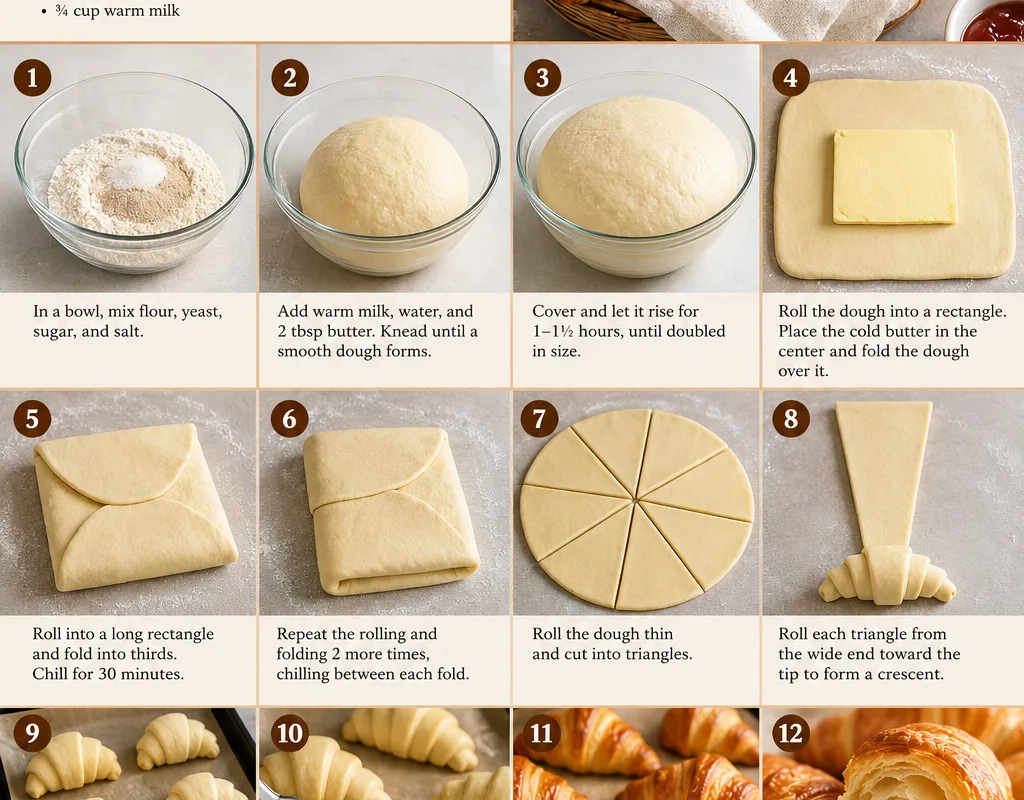
Whisk the flour, sugar, yeast, and salt in a large bowl, then add the warm milk and 2 tbsp softened butter. Stir until a shaggy dough forms, then knead 5 minutes until smooth and slightly tacky.
2. Chill the Dough
Flatten the dough into a 1-inch-thick rectangle, wrap it in plastic, and refrigerate for at least 1 hour until firm and cold to the touch.
3. Prepare the Butter Block
Pound the cold laminating butter between two sheets of parchment into a 7×7-inch square. If it cracks, let it soften for 2 minutes, then re-chill until pliable but still cold.
4. Lock in the Butter
Roll the chilled dough into a 10×10-inch square, place the butter block diagonally in the center, and fold the four dough corners over it like wrapping a present. Pinch the seams closed.
5. Roll and Fold
Roll the packet into a 10×20-inch rectangle, then fold it into thirds like a business letter. Wrap and chill 30 minutes. Repeat this roll-and-fold two more times, chilling 30 minutes between each.
6. Shape the Triangles
Roll the dough to a 1/4-inch-thick, 20-inch-long rectangle and cut it into long triangles about 4 inches wide at the base. Cut a small notch in each base, then roll from base to tip, stretching gently as you go.
7. Proof Until Puffy
Place the shaped croissants on parchment-lined trays, cover loosely, and let them rise at room temperature for 1.5 to 2 hours until visibly puffy and jiggly, roughly doubled in size.
8. Bake to Golden Perfection
Preheat the oven to 400F (200C). Brush the croissants with egg wash and bake 15 minutes, then reduce to 350F (175C) and bake 15 to 18 minutes more, until deep golden brown and the internal temperature reads 200F (93C).
Delicious Variations
Chocolate Croissants
Tuck two squares of dark chocolate along the base before rolling for a molten, pain-au-chocolat-style center.
Almond Croissants
Split baked croissants, brush with simple syrup, pipe in frangipane, and top with toasted sliced almonds.
Ham and Gruyere
Skip the sugar in the dough, then layer thin ham and nutty Gruyere before rolling for a savory brunch star.
How to Store Homemade Croissant 🥐
Refrigerator
Store fully baked croissants in an airtight container at room temperature for 2 days; refrigeration makes them soggy, so avoid it unless you plan to reheat.
Freezer
Freeze unbaked, fully shaped croissants on a tray until solid, then transfer to a freezer bag for up to 2 months. Thaw overnight in the fridge, then proof and bake.
Reheating
Reheat baked croissants in a 325F (165C) oven for 5 to 7 minutes to crisp the outside without drying the center. Skip the microwave, which turns them rubbery.
Frequently Asked Questions
Q: Why is my butter block cracking when I roll it?
Cold butter that's too firm shatters instead of bending. Let it sit at room temperature for 3 to 5 minutes, then re-chill briefly until it's pliable but still cold to the touch.
Grab your rolling pin, crank the kitchen radio, and give these a shot this weekend. Your first batch might look a little lopsided, and that's completely fine; lopsided croissants still taste like victory. Tag me in your golden, buttery results, and remember: Keep your pen dancing.

Homemade Croissant 🥐
Homemade Croissant 🥐 delivers shatteringly flaky, buttery layers you can actually pull off at home with a chill-and-fold method and zero fancy equipment.
🧂 Ingredients
- 4 cups (500g) bread flour, plus extra for dusting
- 1/2 cup (100g) granulated sugar
- 2 1/4 tsp (7g) active dry yeast
- 1 1/4 cups (300ml) whole milk, lukewarm (about 100F/38C)
- 1 1/2 tsp (9g) fine sea salt
- 2 tbsp (28g) unsalted butter, softened, for the dough
- 1 1/2 cups (340g) European-style unsalted butter, cold, for laminating
- 1 large egg, beaten with 1 tbsp water, for egg wash
📋 Instructions
- 1Mix the Base Dough — Whisk the flour, sugar, yeast, and salt in a large bowl, then add the warm milk and 2 tbsp softened butter. Stir until a shaggy dough forms, then knead 5 minutes until smooth and slightly tacky.
- 2Chill the Dough — Flatten the dough into a 1-inch-thick rectangle, wrap it in plastic, and refrigerate for at least 1 hour until firm and cold to the touch.
- 3Prepare the Butter Block — Pound the cold laminating butter between two sheets of parchment into a 7×7-inch square. If it cracks, let it soften for 2 minutes, then re-chill until pliable but still cold.
- 4Lock in the Butter — Roll the chilled dough into a 10×10-inch square, place the butter block diagonally in the center, and fold the four dough corners over it like wrapping a present. Pinch the seams closed.
- 5Roll and Fold — Roll the packet into a 10×20-inch rectangle, then fold it into thirds like a business letter. Wrap and chill 30 minutes. Repeat this roll-and-fold two more times, chilling 30 minutes between each.
- 6Shape the Triangles — Roll the dough to a 1/4-inch-thick, 20-inch-long rectangle and cut it into long triangles about 4 inches wide at the base. Cut a small notch in each base, then roll from base to tip, stretching gently as you go.
- 7Proof Until Puffy — Place the shaped croissants on parchment-lined trays, cover loosely, and let them rise at room temperature for 1.5 to 2 hours until visibly puffy and jiggly, roughly doubled in size.
- 8Bake to Golden Perfection — Preheat the oven to 400F (200C). Brush the croissants with egg wash and bake 15 minutes, then reduce to 350F (175C) and bake 15 to 18 minutes more, until deep golden brown and the internal temperature reads 200F (93C).

Priya explores creative writing prompts and storytelling techniques for aspiring authors. She shares exercises to spark imagination and build narrative confidence, drawn from her own writing practice.


