

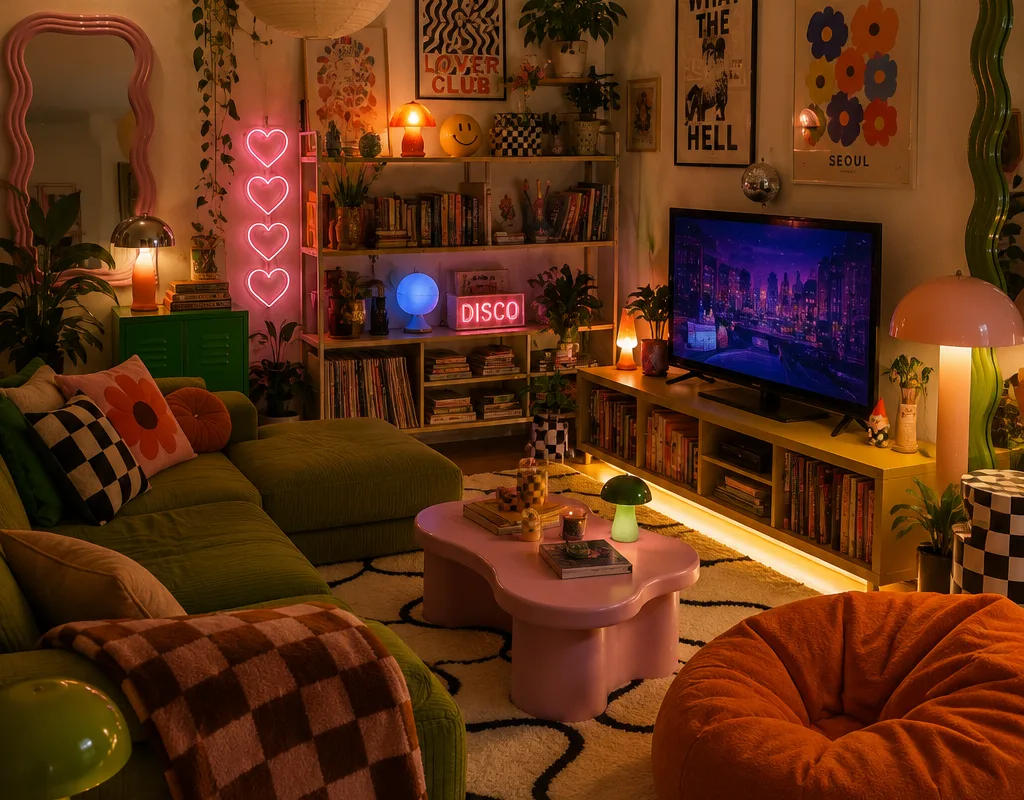
The pin promise is simple: a colorful, eclectic living room that feels cozy, layered, and unmistakably yours. Not a showroom. Not a beige box. A room with bookshelves, bean bags, vintage finds, and lighting that actually makes you want to sit down.
Advertisements1
Here is the practical version. Fifteen concrete ideas, each with what it is, why it works, and who it fits. No hype, no promises that a $12 cushion will change your life. Just design moves that hold up when you actually live in the room.
Table of Contents(Click to Toggle)
- Why Eclectic Maximalism Works in Real Living Rooms
- 15 Colorful Eclectic Living Room Ideas
- 1. The Anchor Sofa in a Saturated Color
- 2. A Gallery Wall With Mixed Frame Sizes
- 3. Open Bookshelves as the Main Backdrop
- 4. Two or Three Bean Bags Instead of a Single Armchair
- 5. Layered Vintage Rugs in Clashing Patterns
- 6. A Statement Floor Lamp as Sculpture
- 7. Warm Bulbs at 2700K or Lower
- 8. A Patterned Accent Chair That Does Not Match
- 9. Throw Pillows in Odd Numbers and Mixed Textures
- 10. A Low Console Behind the Sofa
- 11. Plants at Three Different Heights
- 12. A Collected Coffee Table, Not a Styled One
- 13. One Wall in a Deep, Unexpected Color
- 14. Textiles on the Walls, Not Just the Floor
- 15. A Dedicated Corner for One Weird Object
- Bonus Mentions
- The Rules Behind the Chaos
Why Eclectic Maximalism Works in Real Living Rooms
Minimalism asks you to remove things until the room looks calm. Maximalism asks a harder question: what do you actually own, and how do you make it look intentional? For most people, the second question is more honest. You already have the books, the inherited chair, the rug from a trip, the poster you never framed.
There is also a math argument. A neutral living room needs expensive pieces to look finished, because there is nothing to distract the eye. A layered room distributes attention. A $40 vintage lamp next to a $900 sofa reads as a decision, not a budget compromise. That is the entire trick.
The risk is real, though. Eclectic turns into cluttered when there is no repeat of color or shape. The fix is a simple rule: pick three colors and repeat each one at least three times across the room. Three repeats is the minimum for the eye to register a pattern instead of noise.
15 Colorful Eclectic Living Room Ideas
1. IKEA : The Anchor Sofa in a Saturated Color
What it is: A single large sofa in a strong color — mustard, rust, deep teal — as the base everything else plays off.
Category: Core furniture
Why it stands out:
- One bold piece does more work than ten small accents.
- Slipcovers from IKEA let you change the color for under $200 instead of replacing the sofa.
- Works with almost any rug pattern because the sofa is a solid block of color.
Best for: Renters who want a strong base they can take to the next apartment.
2. Etsy : A Gallery Wall With Mixed Frame Sizes
What it is: Six to twelve pieces hung together with deliberately different frame sizes, finishes, and media.
Category: Wall decor
Why it stands out:
- Mixing gold, black, and natural wood frames prevents the matching-set look that reads as a hotel.
- Etsy sellers offer vintage prints and original art from $15, so the wall grows over time.
- Keep 2 to 3 inches between frames; tighter spacing looks intentional, wider spacing looks accidental.
Best for: Anyone with a blank wall and a stack of unframed prints.
3. Wayfair : Open Bookshelves as the Main Backdrop
What it is: Floor-to-ceiling open shelving behind the seating, filled with books, objects, and a few gaps.
Category: Storage and display
Why it stands out:
- Books add color for free. A shelf of spines is cheaper than any wallpaper.
- Leave roughly 20 percent of each shelf empty so the eye can rest.
- Wayfair’s modular units start around $150 and can be extended later.
Best for: Readers who want storage that doubles as the room’s focal point.
4. Amazon : Two or Three Bean Bags Instead of a Single Armchair
What it is: Filled bean bag chairs in different colors and fabrics, grouped where an armchair would normally sit.
Category: Flexible seating
Why it stands out:
- Three bean bags cost less than one mid-range armchair and seat more people.
- They move. Movie night, reading corner, extra seating for guests — same object.
- Choose shredded foam fill over polystyrene beads; it holds shape longer and does not crunch.
Best for: Small apartments and households with kids or teens.
5. Rugs USA : Layered Vintage Rugs in Clashing Patterns
What it is: A large neutral base rug with a smaller patterned rug laid on top at an angle.
Category: Floor texture
Why it stands out:
- Layering lets you use a cheap large rug underneath and spend on the smaller statement piece.
- Two patterns work when they share one color. A red Persian over a red-toned kilim reads as a pair.
- Use a thin anti-slip pad between layers; the top rug will slide otherwise.
Best for: Renters covering worn or ugly flooring without a full replacement.
6. Article : A Statement Floor Lamp as Sculpture
What it is: One oversized arc or tripod floor lamp that reads as an object, not just a light source.
Category: Lighting
Why it stands out:
- An arc lamp over the sofa replaces a ceiling fixture and adds height to a low room.
- Article’s mid-century styles sit in the $200 to $400 range, well below designer equivalents.
- Measure the arc reach before buying; a 90-inch arc needs clearance behind the sofa.
Best for: Rooms with low ceilings and no overhead wiring.
7. Philips Hue : Warm Bulbs at 2700K or Lower
What it is: Smart bulbs set to warm white, with a few colored accent bulbs for evening.
Category: Lighting control
Why it stands out:
- Color temperature changes the mood more than any decor purchase. 2700K reads cozy; 4000K reads office.
- Hue bulbs let you set a warm scene at 6pm and a dim amber scene at 10pm without new fixtures.
- A starter kit runs about $130 for three bulbs and a bridge — the cheapest dramatic upgrade in the room.
Best for: Anyone whose living room feels cold at night despite good furniture.
8. Chairish : A Patterned Accent Chair That Does Not Match
What it is: One vintage chair in a bold stripe, floral, or geometric print placed opposite the sofa.
Category: Vintage furniture
Why it stands out:
- A mismatched chair is the fastest signal that a room was collected, not ordered from one catalog.
- Chairish lists vintage and antique pieces with condition notes, so you know what you are buying.
- Keep the chair’s dominant color present somewhere else — a cushion or a book spine — to tie it in.
Best for: Shoppers willing to wait for the right one-off piece.
9. Target : Throw Pillows in Odd Numbers and Mixed Textures
What it is: Five or seven pillows combining velvet, linen, kilim, and one solid color.
Category: Soft accents
Why it stands out:
- Odd numbers look arranged; even numbers tend to look symmetrical and stiff.
- Mix at least three textures. Color alone is not enough at close range.
- Target’s Threshold line offers 20-inch covers from $15, so you can rotate seasonally for little cost.
Best for: Quick refreshes when the room feels flat but the budget is tight.
10. West Elm : A Low Console Behind the Sofa
What it is: A narrow table behind a floating sofa, used for lamps, books, and drinks.
Category: Space planning
Why it stands out:
- It creates a visual boundary in an open-plan room without building a wall.
- Two small lamps on the console give you layered light at eye level, which is softer than overhead.
- Keep the console 12 to 14 inches deep so walkways stay clear.
Best for: Open-plan apartments where the sofa floats in the middle of the room.
11. The Sill : Plants at Three Different Heights
What it is: One floor plant, one mid-height plant on a stool, and one small plant on a shelf.
Category: Living decor
Why it stands out:
- Three heights create a vertical line that makes a low room feel taller.
- The Sill ships plants matched to your light conditions, which cuts the usual trial-and-error losses.
- Cluster them within one sightline; scattered single plants look like afterthoughts.
Best for: Rooms with one good window and no direct sun.
12. CB2 : A Collected Coffee Table, Not a Styled One
What it is: A table holding three or four real objects — a stack of books, a candle, a tray, a small bowl.
Category: Surface styling
Why it stands out:
- Objects you actually use look better than a staged vignette, because they change weekly.
- One tray corrals small items and stops the surface from reading as clutter.
- CB2’s round tables in the $300 to $500 range suit small seating groups better than large rectangles.
Best for: People who want a lived-in look without constant restyling.
13. Farrow & Ball : One Wall in a Deep, Unexpected Color
What it is: A single accent wall in deep green, ink blue, or terracotta, with the other walls kept light.
Category: Color strategy
Why it stands out:
- One dark wall makes light furniture and art pop and costs far less than painting the whole room.
- Deep colors hide scuffs better than pale neutrals in high-traffic rooms.
- Farrow & Ball’s estate emulsion covers well but needs two coats over existing dark paint.
Best for: Renters with permission to paint, or owners testing a bolder direction.
14. Society6 : Textiles on the Walls, Not Just the Floor
What it is: A woven wall hanging, tapestry, or framed textile hung like art.
Category: Wall texture
Why it stands out:
- Fabric softens sound in hard rooms with wood or tile floors.
- Society6 prints tapestries and wall hangings from independent artists, often under $60.
- Hang textiles away from direct sun; fading shows faster on dyed fiber than on canvas.
Best for: Rooms that echo and feel cold no matter how much furniture you add.
15. eBay : A Dedicated Corner for One Weird Object
What it is: A deliberate spot for the odd thing you love — a vintage sign, a ceramic animal, a model ship.
Category: Personal curation
Why it stands out:
- One strange object gives the room a story that no catalog can replicate.
- Give it space. An object crowded by others reads as clutter; alone, it reads as a collection.
- eBay is where discontinued and one-off pieces surface, often for less than retail reproductions.
Best for: Anyone with a piece they keep hiding in a closet.
Bonus Mentions
Anthropologie : Statement Hardware and Handles
Swapping cabinet or door handles is a two-hour project that shifts the whole room’s personality. Their mixed-metal options run $8 to $18 each, so a full kitchen or console refresh stays under $150.
1stDibs : Research Before You Buy Vintage
Use it to identify makers, periods, and fair prices before buying a vintage chair elsewhere. You may not purchase here, but the listings teach you what authentic mid-century pieces should cost.
IKEA : The Hack Layer
Leg swaps, paint, and new handles turn basic units into custom-looking pieces for around $50 in parts. The trade-off is time, not money.
Etsy : Custom Lampshades
A new shade on an old base changes the light quality and the silhouette for $30 to $70 — cheaper than a new lamp and often better made.
Wayfair : Storage Ottomans That Double as Seating
They hide blankets and board games while adding a color block. Check the weight rating; many support 250 pounds, which is fine for seating but not for standing.
The Rules Behind the Chaos
Eclectic maximalism is not random. It runs on three constraints that keep a layered room from becoming a storage unit.
First, repeat colors. Pick three and place each one at least three times. Second, vary height. A room with objects at floor, seat, table, and eye level feels full without feeling crowded. Third, leave gaps. Empty shelf space and bare wall sections give the eye somewhere to land, which is what separates collected from cluttered.
Budget math helps too. A layered room can be built for roughly $1,200 to $2,500 if you spend on the sofa and lighting and save on rugs, pillows, and wall art. That is the opposite of the neutral-room formula, where the sofa alone often eats the entire budget.
The main risk is buying too fast. Eclectic rooms age well because they accumulate. If you fill every surface in one weekend, you get a themed room instead of a personal one. Buy the anchor pieces first, live with them for a month, then add.
Which corner of your living room is currently doing the least work — and what one object would you put there first?
Stay sharp, stay solvent.

Diego covers personal finance and investing for freelancers and gig workers. His angle is practical money management for irregular income, from budgeting to tax basics.


