

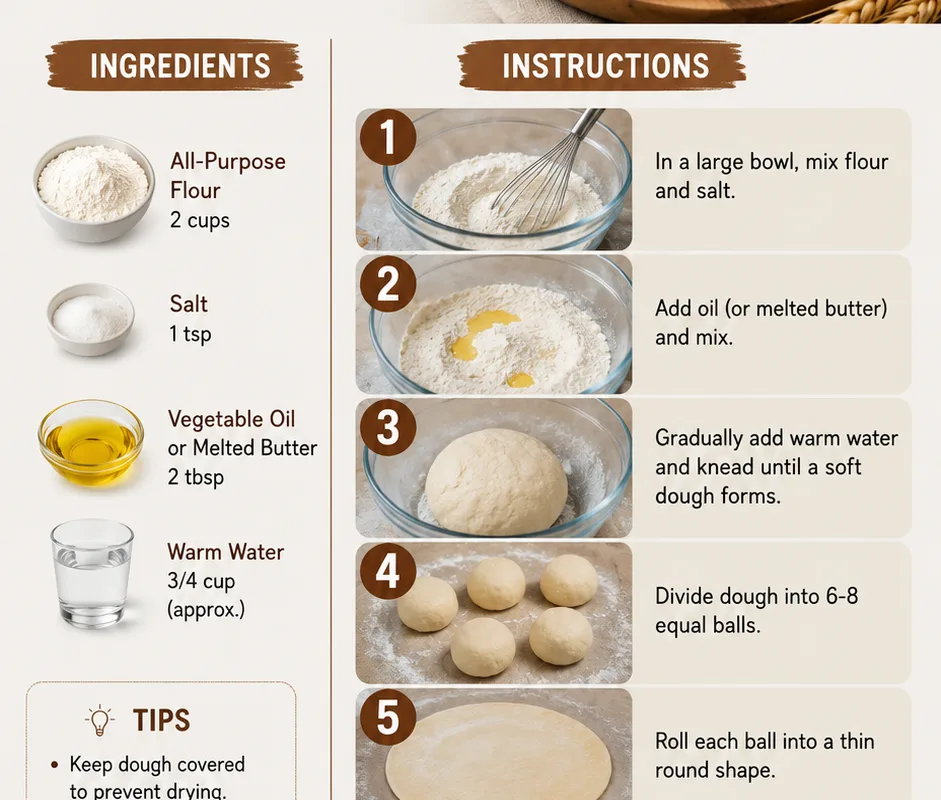
These flour tortillas are made from five pantry ingredients you almost certainly have right now: all-purpose flour, baking powder, salt, lard or shortening, and warm water. The math is simple. A 500g batch of flour yields 12 tortillas at roughly 41g of dough each, which is the size that puffs properly on a dry skillet instead of steaming into a cracker.
Advertisements1
Commercial tortillas stay soft because of preservatives and acidulants. Homemade ones stay soft because of fat and steam. If you knead enough to develop gluten and rest the dough so it relaxes, the tortillas bend without cracking at room temperature for a full day. That is the whole trick, and there is no shortcut around the rest time.
Below I give exact pan temperatures in Fahrenheit and Celsius, a press-or-rolling-pin method that works without a tortilla press, and the three mistakes that ruin most home batches. Follow the numbers and you get soft, blistered, foldable tortillas on the first try.
Why You'll Love This Recipe
About the Ingredients
3 cups (375g) all-purpose flour, plus 2 to 3 tablespoons for dusting
All-purpose is the right protein level here; bread flour makes them chewy and cake flour makes them fragile. If you only have bread flour, cut it with 25% cornstarch by weight.
2 teaspoons (8g) baking powder
Baking powder is what makes the dough puff into a pillow on the skillet. Check the date; powder older than 12 months loses lift, and you can test it by dropping a pinch in hot water.
1 1/2 teaspoons (9g) fine sea salt
Fine sea salt dissolves evenly; kosher flake salt leaves salty pockets. If using table salt, reduce to 1 teaspoon because the crystals are denser.
1/3 cup (65g) lard, vegetable shortening, or rendered beef tallow
Lard gives the most authentic flavor and flakiest texture. Shortening is the neutral vegetarian swap; melted coconut oil works but makes the dough slightly stiffer, so add 1 extra tablespoon of water.
1 cup (240ml) warm water, 100 to 110F (38 to 43C)
Warm, not hot; above 120F (49C) the fat melts out of emulsion and the dough turns greasy. Test with an instant-read thermometer rather than your wrist.
1 teaspoon (5ml) neutral oil, for the bowl and skillet
Any high-smoke-point oil works; you are greasing the bowl for the rest and wiping the pan between tortillas. Do not pour oil into the skillet, or the tortillas fry instead of toast.
Tips & Tricks
Do Not Over-Flour The Counter
too much dusting flour bakes into the tortilla and creates dry, chalky patches. Scrape the bench clean and use 2 tablespoons maximum for the whole batch.
Rest The Dough, Do Not Skip It
20 minutes covered lets gluten relax so the dough rolls thin without snapping back. Dough that fights the pin will always cook up thick and tough.
Keep A Damp Towel On The Stack
cooked tortillas dry out within minutes in open air. Cover them the second they leave the pan, and they stay pliable for hours.
Roll From The Center Outward
pressing straight down flattens the middle and leaves thick edges that never cook through. Work outward in short strokes, rotating the disc a quarter turn each pass.
Pro Tips
Step-by-Step Instructions
1. Whisk The Dry Ingredients
Combine 375g flour, 8g baking powder, and 9g salt in a wide bowl and whisk for 30 seconds so the leavener is evenly distributed. Uneven baking powder means some tortillas puff and others stay flat.
2. Cut In The Fat
Add 65g lard or shortening and rub it into the flour with your fingertips until the mixture looks like coarse sand with no lumps larger than a pea. This coating of fat is what limits gluten development and keeps the tortillas tender.
3. Add Warm Water
Pour in 240ml of 100 to 110F (38 to 43C) water and stir with a fork until a shaggy mass forms. The dough should feel warm, not hot, against your palm.
4. Knead Until Smooth
Turn the dough onto a clean counter and knead 4 to 5 minutes, until it is smooth, slightly tacky, and springs back when poked. Under-kneaded dough tears during rolling; over-kneaded dough shrinks back.
5. Rest The Dough Covered
Shape into a ball, oil the surface lightly, cover with a damp towel or plastic, and rest 20 minutes at room temperature. The gluten relaxes and the dough becomes noticeably easier to stretch.
6. Divide And Roll Into Balls
Cut the dough into 12 equal pieces, about 41g each on a scale, and roll each into a smooth ball. Cover them; exposed balls form a dry skin that cracks when you roll.
7. Roll Each Tortilla Thin
Flatten a ball, then roll from the center outward, rotating a quarter turn between strokes, until you have a 7 to 8 inch (18 to 20cm) disc about 1/8 inch (3mm) thick. If it springs back, let it rest 2 minutes and finish rolling.
8. Cook On A Hot Dry Skillet
Heat a cast-iron or nonstick skillet over medium-high to 400F (204C); a drop of water should sizzle and evaporate in 1 second. Cook each tortilla 30 to 40 seconds per side, flipping when brown spots appear and the surface bubbles, about 60 to 80 seconds total. The finished tortilla should be golden brown in spots, puffed in the middle, and flexible, not crisp.
9. Stack And Cover
Move each cooked tortilla straight into a clean towel-lined bowl and keep it covered. The trapped steam softens the crust, so the stack stays foldable for hours.
Delicious Variations
Whole Wheat Blend
swap 125g of the all-purpose flour for whole wheat and add 2 extra tablespoons of water, since whole wheat absorbs more liquid.
Butter Tortillas
replace the lard with 70g softened unsalted butter for a richer, slightly sweeter flavor; expect a shorter shelf life of about 2 days.
Cilantro-Jalapeno
knead 3 tablespoons minced cilantro and 1 minced seeded jalapeno into the dough after the initial mix for a savory taco-night version.
How to Store Authentic Homemade Tortilla Recipe Step by Step Easy Flour Tortillas with Simple Ingredients
Refrigerator
Cool completely, then store in a zip-top bag with a paper towel for up to 5 days. The towel absorbs condensation that would otherwise make them soggy.
Freezer
Stack with parchment between each tortilla, wrap tightly in foil, and freeze up to 3 months. They thaw without sticking if you separate them before freezing.
Reheating
Microwave a stack of 4 wrapped in a damp paper towel for 20 to 30 seconds, or warm individually in a dry skillet over medium heat for 15 seconds per side.
Frequently Asked Questions
Q: Can I make flour tortillas without lard?
Yes, vegetable shortening, butter, or beef tallow all work in the same 65g quantity. Shortening is the closest neutral substitute; butter adds flavor but reduces the shelf life to about 2 days.
Q: Why are my homemade tortillas hard and stiff?
Almost always too much dusting flour or too little fat. Excess bench flour bakes into a dry crust, so scrape your counter clean and cap the dusting at 2 tablespoons for the whole batch.
Q: Do I need a tortilla press for flour tortillas?
No, a rolling pin works better for flour tortillas because the dough has gluten and needs to be stretched, not crushed. A press is designed for pressable corn masa, which behaves completely differently.
Q: How hot should the skillet be for flour tortillas?
Medium-high heat, roughly 400F (204C), measured with an infrared thermometer or tested with a water drop that sizzles and vanishes in one second. Too cool and they dry out pale; too hot and they char before the inside sets.
Q: How do I keep tortillas soft after cooking?
Stack them in a towel-lined bowl or tortilla warmer the moment they leave the pan. The trapped steam softens the surface, which is the entire reason a covered stack beats a cooling rack.
Make one batch this week and compare it to the bag in your fridge. The ingredient cost is about $1.50 for 12 tortillas, the active time is under 30 minutes, and the texture difference is not subtle. Weigh your flour, respect the 20-minute rest, and cook at 400F (204C). Stay sharp, stay solvent.

Authentic Homemade Tortilla Recipe Step by Step Easy Flour Tortillas with Simple Ingredients
Make authentic homemade flour tortillas with 5 simple ingredients: soft, pliable, and far better than store-bought, ready in about 50 minutes start to finish.
🧂 Ingredients
- 3 cups (375g) all-purpose flour, plus 2 to 3 tablespoons for dusting
- 2 teaspoons (8g) baking powder
- 1 1/2 teaspoons (9g) fine sea salt
- 1/3 cup (65g) lard, vegetable shortening, or rendered beef tallow
- 1 cup (240ml) warm water, 100 to 110F (38 to 43C)
- 1 teaspoon (5ml) neutral oil, for the bowl and skillet
📋 Instructions
- 1Whisk The Dry Ingredients — Combine 375g flour, 8g baking powder, and 9g salt in a wide bowl and whisk for 30 seconds so the leavener is evenly distributed. Uneven baking powder means some tortillas puff and others stay flat.
- 2Cut In The Fat — Add 65g lard or shortening and rub it into the flour with your fingertips until the mixture looks like coarse sand with no lumps larger than a pea. This coating of fat is what limits gluten development and keeps the tortillas tender.
- 3Add Warm Water — Pour in 240ml of 100 to 110F (38 to 43C) water and stir with a fork until a shaggy mass forms. The dough should feel warm, not hot, against your palm.
- 4Knead Until Smooth — Turn the dough onto a clean counter and knead 4 to 5 minutes, until it is smooth, slightly tacky, and springs back when poked. Under-kneaded dough tears during rolling; over-kneaded dough shrinks back.
- 5Rest The Dough Covered — Shape into a ball, oil the surface lightly, cover with a damp towel or plastic, and rest 20 minutes at room temperature. The gluten relaxes and the dough becomes noticeably easier to stretch.
- 6Divide And Roll Into Balls — Cut the dough into 12 equal pieces, about 41g each on a scale, and roll each into a smooth ball. Cover them; exposed balls form a dry skin that cracks when you roll.
- 7Roll Each Tortilla Thin — Flatten a ball, then roll from the center outward, rotating a quarter turn between strokes, until you have a 7 to 8 inch (18 to 20cm) disc about 1/8 inch (3mm) thick. If it springs back, let it rest 2 minutes and finish rolling.
- 8Cook On A Hot Dry Skillet — Heat a cast-iron or nonstick skillet over medium-high to 400F (204C); a drop of water should sizzle and evaporate in 1 second. Cook each tortilla 30 to 40 seconds per side, flipping when brown spots appear and the surface bubbles, about 60 to 80 seconds total. The finished tortilla should be golden brown in spots, puffed in the middle, and flexible, not crisp.
- 9Stack And Cover — Move each cooked tortilla straight into a clean towel-lined bowl and keep it covered. The trapped steam softens the crust, so the stack stays foldable for hours.

Diego covers personal finance and investing for freelancers and gig workers. His angle is practical money management for irregular income, from budgeting to tax basics.


