

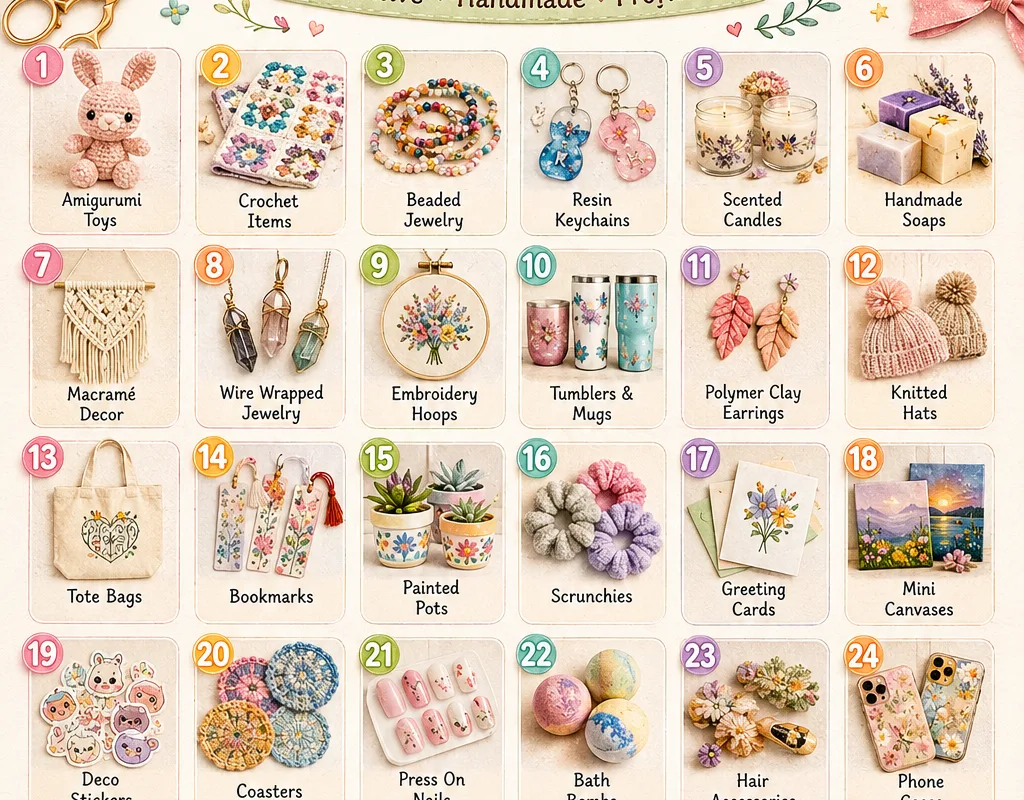
I still remember the first craft fair where I sold out of 40 macramé plant hangers — and then realized I'd priced them so low I made about $6 an hour. That lesson shaped everything I've learned since about which crafts actually make money. Here are 30 crafts worth selling, with the pricing, sourcing, and platform details that turn a hobby table into a real income.
Advertisements1
- Pick crafts where material cost is under one-third of your selling price — otherwise you're working for free.
- Validate demand on Etsy before buying supplies; look for 10+ established shops with strong review counts.
- Batch production cuts your time per unit dramatically — mine dropped from 25 to 9 minutes per pair of earrings.
- Pinterest drives visual-product sales; make 3–5 vertical pins per item with clear benefit text overlays.
- Track profit per hour, not revenue — it's the only number that tells you if this is a business.
How to Pick a Craft That Actually Sells
Before you buy a single skein of yarn, do this: search your craft on Etsy and sort by 'Top Customer Reviews.' If the top 20 listings have fewer than 100 reviews, that's a soft market — either low demand or low trust. I look for niches with 500+ reviews spread across at least 10 shops. That tells me buyers exist and there's room for another seller.
Then check your material cost per unit. A candle that costs $4 in wax and a jar and sells for $18 has a healthy 4.5x markup. A resin coaster set that costs $9 and sells for $15 does not — after fees and shipping, you're working for free. Aim for a minimum 3x material cost, then add your time.
Finally, ask yourself: can I make 20 of these without hating my life? Volume matters. I once tried hand-painting 200 wooden ornaments in December. Never again. Choose crafts where your process gets faster with repetition, not slower.
30 Crafts to Sell, Grouped by Profit Potential
High-margin, low-material-cost (best for beginners): 1) Soy wax candles in thrifted vessels, 2) Macramé plant hangers, 3) Beaded friendship bracelets, 4) Hand-lettered bookmarks, 5) Polymer clay earrings, 6) Crochet coasters, 7) Pressed-flower greeting cards, 8) Bath bombs, 9) Knotted dog toys from fabric scraps, 10) Hand-stamped tea towels.
Mid-tier with strong repeat buyers: 11) Custom pet portraits (digital or painted), 12) Embroidered denim jackets, 13) Resin keychains, 14) Scented wax melts, 15) Leather cardholders, 16) Hand-bound journals, 17) Tie-dye tote bags, 18) Wood-burned cutting boards, 19) Ceramic mugs, 20) Custom family name signs.
Higher-ticket, higher-skill (worth the learning curve): 21) Hand-thrown pottery sets, 22) Stained glass suncatchers, 23) Quilted baby blankets, 24) Custom wedding signage, 25) Macramé wall hangings over 3 feet, 26) Hand-dyed yarn skeins, 27) Wooden toy sets, 28) Bespoke wedding bouquets (faux or dried), 29) Handwoven baskets, 30) Personalized jewelry with birthstones.
My personal best-seller has been #5, polymer clay earrings — $2.10 in materials, $24 retail, and I can batch 30 pairs in an afternoon once the designs are set.
Pricing So You're Not Working for Free
Use this formula: (materials × 3) + (hours × your hourly rate) = wholesale price. Double that for retail. If you can't sell at that number, the craft isn't the problem — the market or your positioning is.
I learned this the hard way with crochet. A baby blanket took me 14 hours and cost $22 in yarn. At $15/hour, that's $232. Nobody pays that at a craft fair. So I switched to smaller crochet items — coasters and market bags — where the time-to-price ratio worked. Know which crafts are 'time traps' and price them for custom orders only, not inventory.
Always factor in platform fees: Etsy takes about 6.5% plus payment processing, and shipping eats more if you guess wrong. I now weigh every package and buy postage through Pirate Ship to save 20–30% versus retail counter rates.
Photography and Listings That Convert Pinterest Traffic
Pinterest sends me about 60% of my shop traffic, and it's almost entirely visual. Your first photo needs to stop the scroll: shoot on a plain white or textured neutral background, natural light, no flash. I use a $12 foam board from the craft store as a reflector — it's made more difference than any camera upgrade.
Write your listing title the way people search: 'Personalized Dog Mom Keychain, Custom Pet Portrait Gift, Leather Keyring' beats 'Cute Keychain.' Use all 13 Etsy tags, and make your first 160 characters of description a clear benefit statement, because that's what shows in Google results.
Create 3–5 vertical pins (1000×1500px) per product with text overlays like 'Gift under $25' or 'Wedding favor idea.' Pin them to relevant boards over 2–3 weeks, not all at once. My best-performing pin was a simple flat-lay of earrings with the words 'Hypoallergenic Gift Under $20' — it drove 1,200 clicks in a month.
Sourcing Materials Without Killing Your Margin
Buy in bulk once you've validated a design. I order wax in 10-pound slabs, clay in 2-pound blocks, and chain by the spool — it cut my per-unit cost by roughly 35% versus buying small packs at the craft store.
For unique materials, thrift stores and estate sales are gold. I've found vintage teacups for $1 that became $22 candles, and old wool sweaters I felted into $18 coasters. Just inspect for chips, stains, and smells before you commit.
Keep a simple spreadsheet: item, supplier, unit cost, date purchased. I resisted this for a year and overpaid because I kept re-buying things I already had. Ten minutes a week saves real money.
Scaling From Side Hustle to Steady Income
Batch your production. Instead of making one item at a time, make 10: cut all the clay, then shape all the earrings, then bake, then assemble. My production time dropped from 25 minutes per pair to 9 minutes once I batched.
Set a weekly minimum — mine is 5 new listings or 10 finished units, whichever comes first. Small consistent output beats sporadic marathon sessions, and it keeps your shop fresh for the algorithm.
Track one number: profit per hour. Not revenue, not units sold. If a craft earns you $8/hour, it's a hobby. If it earns $30+, it's a business worth doubling down on. Revisit this every quarter and drop your lowest performer without guilt.
The Hacks, Step by Step
- 1Validate demand before you buy supplies
Search your craft on Etsy, sort by top reviews, and confirm at least 10 shops with 500+ total reviews. This proves buyers exist before you spend a dollar. - 2Calculate your true cost per unit
Add materials, packaging, and platform fees, then divide by the price you plan to charge. If the margin is under 3x materials, redesign or reprice. - 3Make a 10-unit test batch
Produce 10 identical items to learn your real time-per-unit and spot flaws. One-off prototypes hide problems that show up at volume. - 4Shoot 5 photos in natural light
Use a foam board reflector and a neutral background. Good photos raise perceived value more than any product tweak. - 5Write keyword-first listing titles
Lead with what buyers search ('Personalized Dog Mom Keychain'), not what you call it. Fill all 13 Etsy tags. - 6Create 3 vertical Pinterest pins per product
Design 1000×1500px pins with a text overlay benefit like 'Gift under $25.' Stagger posting over 2–3 weeks. - 7Batch your production weekly
Set a minimum of 5 listings or 10 units per week and do each production step in bulk. Consistency beats bursts.
If a craft earns you $8 an hour it's a hobby; if it earns $30, it's a business worth doubling down on.
Frequently Asked Questions
What is the most profitable craft to sell?
Custom polymer clay earrings and soy wax candles have the best beginner margins, often 4–6x material cost. Both are lightweight to ship and easy to batch-produce once your designs are set.
How much should I charge for handmade crafts?
Use (materials × 3) + (hours × your hourly rate) for wholesale, then double for retail. If the market won't support that number, switch to a smaller or faster-to-make item rather than underpricing.
Can you actually make money selling crafts on Etsy?
Yes, but only with realistic pricing and consistent listing output. Sellers who batch production and track profit per hour typically clear $20–$40/hour; those who price by gut feeling often earn under minimum wage.
What crafts sell best on Pinterest?
Visually striking, giftable items perform best — jewelry, candles, wall hangings, and personalized keepsakes. Vertical pins with a clear price or occasion overlay ('Gift under $25') get the most clicks.
Do I need a business license to sell handmade crafts?
In most US states you need a sales tax permit and possibly a local business license, depending on where you sell. Check your state's revenue department website — it's usually a quick online form and a small fee.


